Showing posts with label England Golf. Show all posts

Thursday, March 27, 2014

Swinley Forest Golf Club

Swinley Forest is completely different from any other club that I have visited. "Extremely exclusive" and "very unusual" only begin to scratch the surface of the club. The membership is comprised largely of British aristocracy and high ranking members of the British military. The Duke of Edinburgh (the Queen's husband) and the Duke of York (the Queen's son) boast membership at Swinley. There is a real sense of occasion when pulling through the imposing gates onto the property. The beautiful traditional clubhouse is exactly what you would expect at a club whose course is ranked #92 in the world.

The 17th Early of Derby founded Swinley Forest, which opened in 1910. The founding principles of the club were eccentric, and nearly all of them have endured to the present day. It has only been in the past decade that the course has been measured. The club history book explains that "every previous attempt to have the course measured was instantly vetoed as being too professional and therefore 'not Swinley.'" Scorecards have also only been consistently printed and used in the last decade. Swinley Forest exists solely for the pleasure of its members, most of whom think the rest of us wring the enjoyment out of golf by taking it too seriously. I saw this personally as the two members in the group ahead skipped from the 11th hole to the 15th, but not before telling me, "feel free to skip ahead with us or play on. Whichever you fancy." 

Complete serenity at Swinley Forest is created both through the beautiful setting and the fact that there are never more than a handful of members playing the course. Even then, most members are just hopping out for a few holes with their dog. The course reminded me of a heathland Augusta National in many ways, especially with an "open" feeling to the course and beautiful vistas across the property. After finishing my round, I had a shower in the locker room and proceeded to join a number of members for lunch in the clubhouse. It is important to emphasize that the exclusivity of Swinley Forest certainly does not equate to unfriendliness. I was treated very well by both members and staff alike. 
Water bowls for dogs are found many of the holes.
Swinley Forest does not host medals, or any serious competitions, on their course. It is also rare that they participate as a club in competitions elsewhere. A section of the history book expands on this topic. "Swinley has two comparatively recent annual fixtures, when they play Sunningdale and the Seniors. They will also sometimes turn out a side for some commemoration or pertinent tournament, such as the Colt Cup... The Club will also field a side for like-minded groups such as the Nibblock Golf Society, made up of members from Augusta National Golf Club and Pine Valley Golf Club." Members do not have handicaps. Outside of the occasional match, those lucky enough to claim Swinley Forest as a home club simply enjoy the great course, and don't worry about such trivial things as scores. 

The course at Swinley Forest is an excellent example of heathland golf. The course architect, Harry Colt, described Swinley in his humble manner as "his least bad course." This is a particularly impressive statement considering Colt's extensive list of great designs, a number of which sit in the top 100 in the world. The overall length of Swinley Forest measures just over 6,000 yards, but with five par 3s and one par 5, the course does not feel short at all. Colt also made excellent use of the terrain, with some very challenging uphill par 4s. While much allure surrounds the club due to its exclusivity and quirky traditions, it is the course itself that takes center stage after spending a day at the club.

Hole #1 - 389 yards
In keeping with Colt's design philosophy, the first hole has a wide fairway and few bunkers. Colt thought that the first two holes should have open fairways, and get players onto the course in a quick manner.

Hole #4 - 184 yards
The fourth hole is one of the best par 3s that I have played while in the UK. This bold statement is backed up by a Redan green sitting on a natural shelf, which is protected by a viciously deep bunker on the front left. This hole is an example of the great use of terrain on the course.

 Hole #5 - 497 yards
This elevated tee shot provides an excellent view of the dogleg right par 5. A bunker sits at the corner of the dogleg, and a small lake protects an area where shorter hitters would lay up.
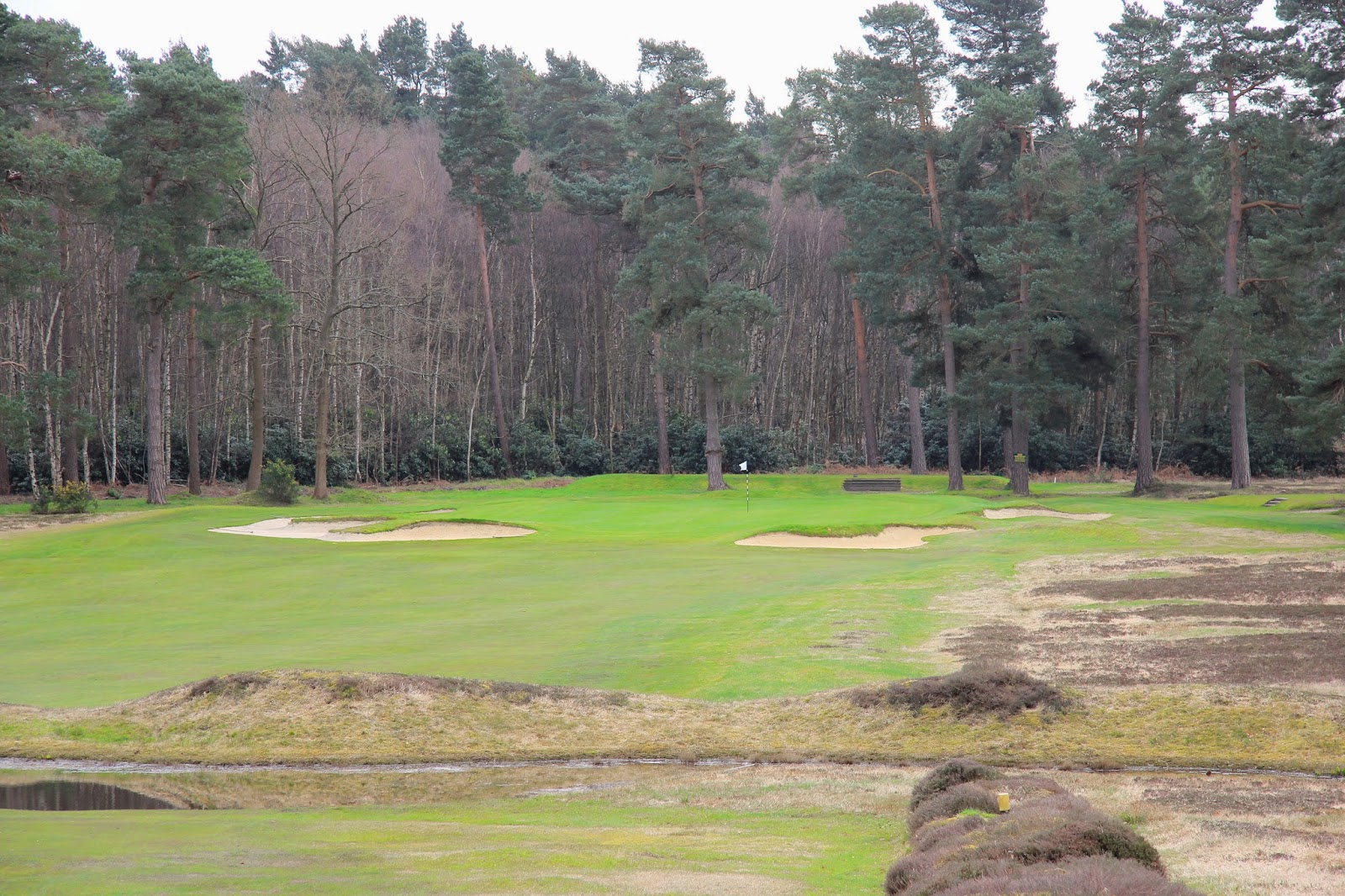
The green is guarded by a number of fairly shallow bunkers. The foliage and heather would be visually stunning during warmer times of the year.

 Hole #6 - 424 yards
The view from this tee is grander than it appears in the above photo. The drive is fairly open, but the challenge during my round was found at the green.

This green complex was similar to others on the course in that one of the bunkers, which appeared to be greenside, was actually thirty yards short of the green. There were a number of holes with similar optical illusions in the bunkering. 

 Hole #7 - 400 yards
This uphill par 4 plays longer than its yardage and features a line of heather covered mounds 260 yards from the tee. The approach shot plays much longer than the yardage and the front right portion of the green is bunkered.

 Hole #8 - 146 yards
The 8th hole is another stellar par 3 at Swinley Forest. The bunker-less hole has a large slope falling off the right side of the green. If you miss on the right side of this green, a lofted shot from 25 feet below the green is required for a par putt.

 Hole #9 - 434 yards
The sweeping right to left fairway presents a beautiful view from an elevated tee. Thick heather protects both sides of the fairway.
The bunker-less green was larger than it appears from the fairway, but this hole was another very challenging par 4 on the 6,000 yard course.

 Hole #10 - 205 yards
The theme of particularly strong one-shot holes should be apparent by this point. The par 3 10th is well bunkered and the sloping green is deceptively small. The entrance to the green is open, and shorter hitters are able to run the ball onto the putting surface.

Hole #11 - 285 yards
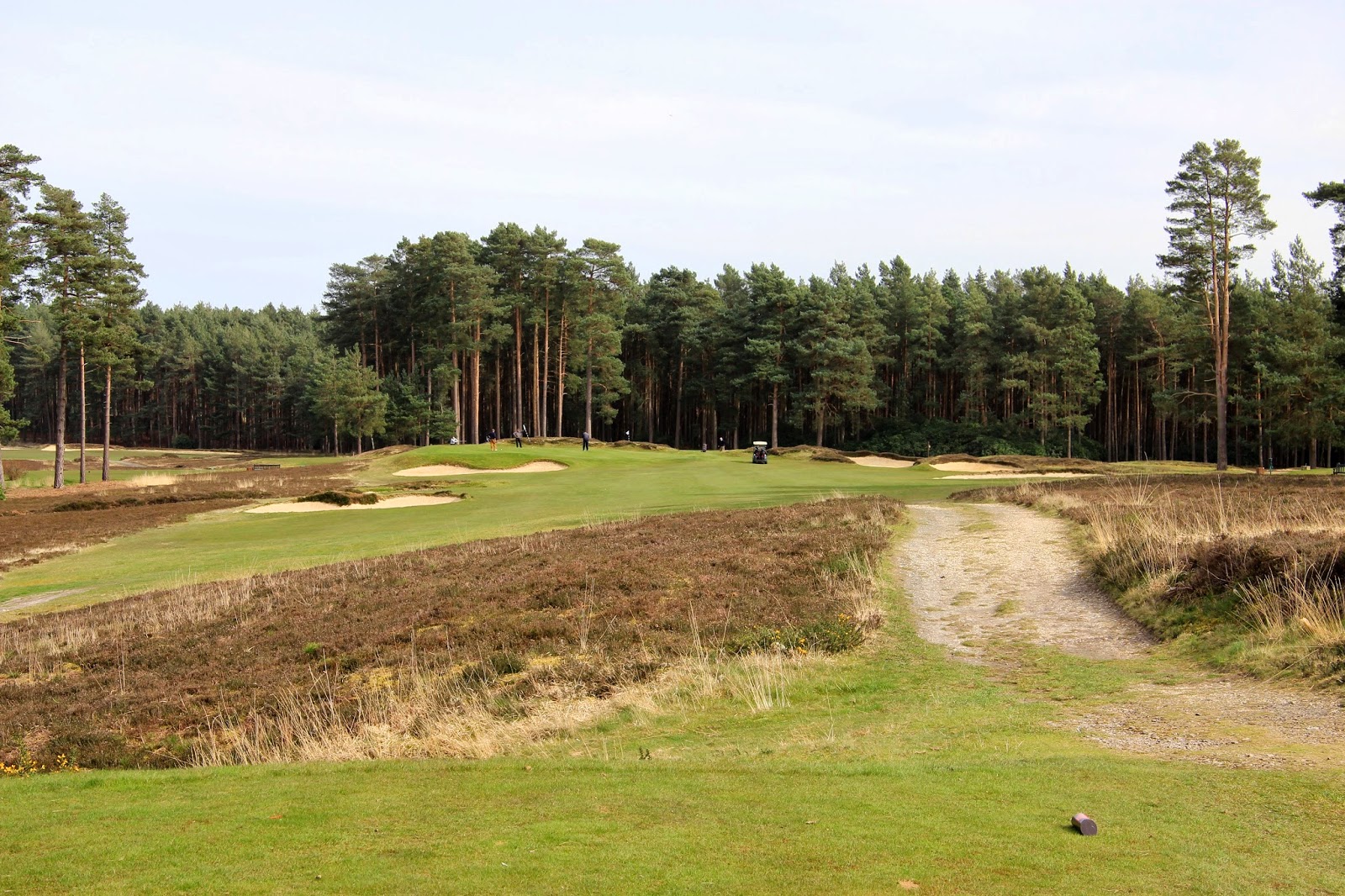
Swinley may only be 6,000 yards, but the 11th was one of only two par 4s under 360 yards. This hole was still no slouch, with heather and bunkers catching any wayward shots.

Hole #12 - 455 yards
The 12th has only greenside bunker and the putting surface slopes heavily back to front. The rhododendron thicket behind the green is one of the largest that I have ever seen, and I can only imagine its beauty when in bloom.

 Hole #13 - 174 yards
This par 3 is framed beautifully by the trees surrounding the back of the green.
Two front bunkers guard the great green complex. It was in this nook of the course, looking back towards holes played earlier, that the beauty and openness of the property really came through.

 Hole #15 - 450 yards
This 450 yard uphill par 4 is another challenging and long hole on the course. The fairway is appropriately wide, but bunkers and a large false front guard the green.
The green slopes heavily back to front and the main objective on approach shots should be reaching the back half of the sloping surface.

 Hole #17 - 170 yards
The final par 3 of the course caps off a masterclass in one shot holes. The raised green slopes off on all sides into heather and deep bunkers. An accurate iron shot is required to hit this small green. I wish I could have had a bucket of balls to practice all afternoon on this hole.

 Hole #18 - 368 yards
The dogleg left finishing hole features a creek running across the fairway. Mid to long hitters can carry the stream and an approach shot is left from the point at which the photo above was taken. The uphill approach is completely blind, and distance control is important as the green slopes back to front.
Bell, originally given by Queen Elizabeth II to an American warship, marks a clear green
I played Swinley Forest the day after playing golf at Wentworth (review here). The two clubs stood a long way apart in their ideologies. The corporate feel at Wentworth was replaced with understated tradition at Swinley. The best way to finish this post is with another quote from the history book that sums up the club very well. "Swinley is an anachronism, living in its Edwardian past. But it is an anachronism that works. Nearly one hundred years on, the membership is drawn from virtually the same families, with a few boasting an unbroken line from a founding member. All subscribe to the original ideas and criteria - a quiet atmosphere, with agreeable colleagues and an old-fashioned lunch."

Thursday, March 20, 2014

Wentworth Golf Club (West Course)

My visit to Wentworth marked my third foray into the great golf that England has to offer. I was excited to play at Wentworth, which has hosted the Ryder Cup in 1926 and 1953 among many other European Tour events. The West course was designed by Harry Colt in 1927 on the Wentworth Estate, and the prestigious club quickly made a name for itself. 
I found my day at Wentworth to be full of interesting juxtapositions. Unfortunately, there is a sense that the club is run by corporate offices, rather than a committee of golfers trying to offer the best to the members. A corporate feel leaks out of every pore, but just occasionally, a bit of the traditional English club shines through. I will outline some of the reasons below. 
The price to play Wentworth (West) is exorbitant. Between January and March, the price is £195 per round, followed by £250 per round in April, and £360 (caddie included) per round between May and October. In another strange twist, golfers have to purchase range ball coins from the pro shop at £5 for a small bucket. This felt like eating dinner at a Michelin starred restaurant and being charged for bread with your meal. Additionally, a large section of the range is "sponsored" by TaylorMade. This "TaylorMade Lab" is a large fitting center attached to the practice facility, and their branding surrounds you everywhere. I hit my TaylorMade practice balls with a Dustin Johnson advertisement staring me down. It was as far away as you could get from a traditional English club.
A sign on the first tee
In terms of course design, little of the original Colt design is recognizable, obscured by a layout clearly made for European Tour golf tournaments. A passage in the West course StrokeSaver reads, "...with recent advances in golf ball and equipment technology it became necessary to carry out a programme of restoration and modernization in order to restore Colt’s original shot values. There was no better man to head-up that sensitive task than long-time Wentworth resident and respected golf course architect Ernie Els, also a seven-time winner on the West Course... This project involved the construction of 18 new greens including a spectacular new finishing hole... All green side and fairway bunkers were reviewed, remodeled and where necessary repositioned more in keeping with today’s shot patterns." I would argue that Els's work was a full redesign rather than a restoration. Thirty bunkers were added to the course, along with hundreds of yards of length to make the course suitable for European Tour events. The result is a very challenging, aesthetically pleasing, and enjoyable golf course. However, the course lacks character in areas, and it resembles very little of Colt's original design. 
 Hole #1 - 465 yards
The first hole is a short par 5, which features a gorgeous approach shot. The tee shot is straightforward, except for a road and accompanying traffic that pass in between opening shots. Roads dissecting the course were common, with over 11 holes featuring roads, by my count.

 Hole #3 - 442 yards
This par 4 is one of several character-lacking holes on the course. The straight hole features a grouping of bunkers in the landing area, followed by two green side bunkers on the front left and right of the green. It is by no means a bad hole, but follows the formula required to comply with "USGA tournament specifications."
Additionally, the conditioning of the greens was disappointing given the time of year and greens fees. You would expect any course that charges £195 to have the highest quality conditions, even during the spring months. Further, the 2nd hole was even played to a temporary green, set 40 yards short of the putting surface.

 Hole #4 - 485 yards
This dogleg left par 5 featured yet another stunning approach shot. Longer drives reach the bottom of the hill, while shorter tee shots have to contend with the creek crossing the fairway for a layup. One of the largest private homes that I have ever seen borders the right side of this hole. 

 Hole #6 - 342 yards
This green complex on the sixth hole represents much of the bunkering found later in the round. Bunkers flank the right and left entrances to the slightly raised green. Many of these raised greens create semi-blind approach shots, which don't necessarily detract from the round, but do make it difficult having never seen the course.

 Hole #8 - 388 yards
The 8th hole is a short par 4 that, while fun to play and nice to look at, would not resemble Colt's original design. The approach shot is over a lake to a raised green guarded by a single bunker on the front right.

 Hole #10 - 174 yards
This great par 3 is a glimpse of one of Wentworth's traditional features. This classic one shot hole is a long, narrow green with two bunkers right of the green. The hole is a great use of the landscape and could be found on any top 100 heathland course in England.

 Hole #12 - 475 yards
This unique tee shot has to be played over, or between, the large trees guarding the fairway. The dogleg left par 5 was one of my favorite holes on the course. Shorter hitters would definitely struggle with the trees and tee shot... Imagine Augusta National's Ike's Tree taken to the next level.
Layups are guarded by a small stream crossing the fairway, and a raised green is yet again guarded by two bunkers on the front left and right. 

Hole #15 - 458 yards
This is the number 1 handicap hole on the course, and, although it cannot be seen in this photo, a stream runs up the right side of the hole before eventually crossing the fairway at around 300 yards from the tee. Bunkers guard the green that slopes off the back. 

 Hole #17 - 549 yards
Two par 5s conclude the round and this, the 17th, is the first of the difficult duo. The dogleg left hole features a beautiful approach shot to a green with no bunkers, which may likely be the only bunker-less green on the course.

 Hole #18 - 491 yards

Tough third shot...
The finishing hole was completely re-designed by Els and his team. The par 5 is a sharp dogleg right, with an approach shot over a small lake. The hole is fun and challenging, but it follows the template for a European Tour finishing hole. This is not a bad attribute, but it has no resemblance to Colt's original design, and this fact will bother design purists. 

I enjoyed my round at Wentworth. Arriving at the castle clubhouse and observing the gargantuan 30,000+ square foot homes bordering the course certainly create a sense of occasion. However, two questions rattled around my brain during the round. First, does the course deserve to regain its previous world top 100 rating? Not in my opinion. The design now lacks character and subscribes to the formula of so many other European Tour courses. Second, and more important, would I recommend that someone spend £360 to play the course in the summer? Considering that you could play two rounds on the St Andrews Old Course and stay one night in a local B&B for the same price... the choice is yours.

Sunday, November 17, 2013

Ganton Golf Club

Our trip to North Yorkshire's Ganton Golf Club was a great day filled with history and enjoyable golf. The trip down south was paired with a round at Woodhall Spa (review here), and, as with that review, you will see me draw comparisons between the two clubs.
Ganton's beautiful clubhouse and locker room typify a traditional old golf club within the UK. The walls are packed with old photographs, framed letters, and names that act as an encyclopedia for UK golfing history. The course was first laid out in 1891, and to the visiting golfer, it feels that the best of the "old" has been preserved. 
Ganton Golf Club is rife with British golfing history. The club boasts a who's who of previous club pros, including Harry Vardon, who came as professional in 1896. It was during his tenure as pro that he won the first three of his six Open Championships. He also returned to Ganton in 1900 after winning the US Open. Ted Ray was another Ganton Professional (1903 – 1912) who won the Open Championship and the US Open. The locker room walls feature portraits of Ganton's professionals.
The course itself has been touched by some of the best golf architects to have lived. James Braid, JH Taylor, and Harry Vardon all contributed to a major redesign of the course in 1905. Harry Colt (1907, 1911 & 1931), Dr Alister McKenzie (1912 & 1920), Tom Simpson (1934) and CK Cotton (1948 & 1952) have all added their own improvements to the course. While some might argue that a few too many cooks have contributed to the recipe, it would be hard to choose a better list of chefs! 
The greens were in great condition for our round. The fairways left something to be desired, but we were playing at the tail end of a long golfing season. Very strong winds (30mph+) made the day challenging, but meant that this already "linksy" course played even more like a seaside round.

Hole #1 - 359 yards
The course opens slowly with a slight dogleg right first hole. Large bunkers guard both sides of the fairway and alert golfers that large hazards will be a factor throughout the entire round.

Hole #2 - 395 yards
The second green was tough when we played the course and would be especially so when the greens are in fast shape mid-summer. The green slopes away from players, and any pin placement towards the front of the green would pose a difficult challenge. A bunker in the fairway uses railroad ties on the rear wall of the bunker. This reminded me of both Prestwick Golf Club here in Scotland and some of the Pete Dye courses that I grew up with back in the States. 

 Hole #3 - 288 yards
The third is a short par 4 that is straightforward until you get a bit greedy. A large bunker guards the left side of the fairway and OB runs along the right side of the hole. A creek runs behind the green and once on the putting surface, no two putts are guaranteed. I decided to get greedy before pulling my tee shot left and making double bogey.

 Hole #5 - 148 yards
All of the par 3s on the course were strong. The fifth was particularly enjoyable and picturesque. Green side bunkers guard the putting surface and the sheer size of the traps is not realized through these photos. 

 Hole #6 - 438 yards (par 5)
The sixth hole is a good example of making an interesting par 5 out of a completely flat piece of land. Cross bunkers protect the fairway. The hole may seem particularly short, but the tees were set back during our round, and the hole can be stretched out to a much longer distance than that on the card.

Hole #9 - 499 yards
The fairway on this long par 5 is narrow and the tee shot sets up particularly well to the eye. The strength of this hole lies with the interesting and challenging green complex. The sloping green is guarded by deep bunkers that eat up not only green side shots, but also misplaced layups. This was one of my playing partner's favorite holes on the course. 

Hole #10 - 165 yards
This par 3 was one of my favorite holes on the course. The green is long and has a slight concave bowl shape. If you hit this green with the correct distance, you will be very close to the hole. However, similar to many of the holes at Ganton, miss this green and you will be in very deep bunkers. 

 Hole #11 - 398 yards
The tenth green is fairly flat and uninteresting, but the challenge comes during the approach shot. Particularly long hitters, or particularly bad iron players, will be challenged by the cross bunkers 90-110 yards short of the green. A massive bunker is right of the green. The size and depth of the bunker barely comes through in the photo.

Hole #15 - 427 yards
The final stretch of holes at Ganton are very strong. If I were to play the course again I would simply be biding my time until I got to these final four holes. The left hand fairway bunker is a ball magnet off of the tee. The length of the bunker becomes clearer when you see my playing partner in the very front of the trap in the photo above.

 Hole #16 - 427 yards
A straight ball is paramount on this blind tee shot. The fairway narrows down, and trees lining the fairways affect the line of any approach shot not from the center of the fairway. I really enjoyed this hole, even from the left trees. No lead would be safe coming into the final three holes. 

 Hole #17 - 235 yards
The seventeenth hole is one of the top par 3s that I have played. That is a bold statement, but I stand behind it. I am not always a fan of the very long par 3. I like this hole because the front of the green is open and hazard-free. If you don't have the length to reach the green, that is fine! Just keep your ball straight to avoid massive bunkers.

Hole #18 - 387 yards
The eighteenth is a sharp dogleg left with a blind tee shot. A driver or 3 wood off the tee leaves 120-160 yards to the green. Strangely, the long, beautiful entrance road intersects with this hole's fairway, and the road is marked OB. The road is roughly 80 yards short of the green. I thought it was a little too quirky to have OB in the center of the fairway. If you catch your approach shot heavy, you could end up out of bounds in the middle of the hole. Out of bounds marks the boundaries of the course, not roads bisecting holes. On another note, to give you a sense of the wind during our round, my playing partner hit a 3-iron from 130 yards just over the back of the green for his approach shot.

The long entrance road builds a sense of occasion.
I really enjoyed Ganton Golf Club. It was a very good balance of great golf club and great golf course. If I had to choose one or the other between Ganton and Woodhall Spa, I would choose to play my golf at Ganton. I am a sucker for tradition and history. When it comes to the quality of golf, I think that Woodhall Spa wins slightly, but not nearly by a large enough margin to make me choose it over Ganton. If visiting northern England with your golf clubs, play both!