The feeling of playing Pine Valley will be tough to beat. Passing the security gate, a new world is entered. It is a unique world where golf is the main and only focus. The Pine Valley history book in the pro shop calls it “A Unique Haven of the Game.” It is a common thread found in most write-ups about Pine Valley: the club has no frills or unnecessary features. Golf is the goal, and they do it right! (The #1 in the World ranking speaks strongly)

The weekend of my Pine Valley round included 25 hours of driving, which covered 1420 miles. On the day of the round, I felt like a kid waking up on Christmas morning. It was a fifteen-minute drive to the course, so I naturally planned on the drive taking an hour. No amount of traffic or car troubles would keep me from being on time. After the drive only took twelve minutes, I sat in a CVS parking lot trying to control my hyperventilation and butterflies. I still hadn’t quite settled down when I pulled up to the Pine Valley gate, but things got much better once the attendant checked my name off the list.
I was able to drive my car all the way to the south end of the driving range where I met the member who would be hosting me for the round. The range at Pine Valley is very impressive. It is double-sided and as large as an entire golf course in itself. After warming up and getting fairly loose on the dreamlike expanse of a range, we headed back toward the clubhouse and first tee to begin what would be one of the most enjoyable rounds I’ve ever played.

George Crump designed Pine Valley and it was his only design. He passed away before the completion of the 12th-15th holes, but, on account of his meticulous design notes, those holes were completed just as he had envisioned them. The cost of construction of the course and clubhouse was $100,000. The original 250 memberships sold for $100 each. The good old days! For the remaining $75,000, bonds were issued and members were urged to subscribe. One member purchased $50,000 worth of the bonds: presumably, George Crump, himself. (Talk about having trust in your creation!) The Pine Valley history book speaks extensively on these beginning days of the course.
I won’t get into the specific shot-by-shot aspects of the round. That being said, I do want to highlight birdies of mine on the 3rd, 4th, and 7th holes. Keep in mind (or look at the photo of the scorecard), the 7th hole is the #1 handicap hole. It is also the hole that features the infamous “Hell’s Half Acre,” which is an expanse of sand and scrub that consumes golf balls as a child eats M&Ms.

The par 3 10th has the famous “Devil’s Asshole” bunker guarding the front right portion of the green. During the round, I dropped a ball into the bunker just to see if I would be able to get out. I have learned to hit out of many deep bunkers, including, on a nearly weekly basis, the cavernous Road Hole Bunker on the Old Course. No matter how well I struck the ball in this bunker, it was not coming out. That darn bunker is the deepest small trap I have ever encountered. It’s the combination of small size and extreme depth that makes it so difficult. I couldn’t get out after multiple swings. Eventually, the member and my caddie, who had been chuckling at my futile efforts, tossed me a hybrid and told me to swing away. Running the ball up the face with a low lofted club was one of the few ways, which I would never have considered, to get out. Gotta love some local knowledge!
I bogeyed the 17th hole and parred the 18th to finish with a +5 75. I played solid golf and was able to get around in a respectable fashion. In order to score well at Pine Valley, you have to hit fairways. They are large! If the golfer misses the fairway, a price is to be paid. I only missed three during my round. I made 3 doubles on those holes. A section out of the Pine Valley history book, which is sold in the pro shop, describes the course best: “The inspiring principle of Pine Valley’s design is simplicity in itself: the island. The tee is an island. The fairway, almost 50-55 yards wide in the tee-shot landing area, is also an island (or two). So is the green. Each of these isolated plots is virtually surrounded by sand, scrub, dense woods, sometimes water, sometimes severe slopes, a vast no-man’s land, as it were of potentially unplayable lies. And woes betide the man who… fails to put in consistently at a safe harbor. The penalty ranges from double bogey to incalculable.”
My caddie for the round was a friend of mine with whom I have played golf on the Old Course. He balanced helpful advice and knowledge of the course masterfully against trust in my own personal knowledge of my golf game. Thank you, Joe, for helping me get around the course in 75 strokes!
Short Course:
After our round on the “Big Course,” we made our way off the green and my host asked, “Graylyn, are you in a hurry to get anywhere this afternoon?” After momentarily weighing my alternative of an afternoon sitting in a hotel room, I calmly responded that I was free. He asked if I wanted to play the ten holes of the Short Course after a pint or two in the clubhouse. I couldn’t have pictured a better way to follow up an amazing round.

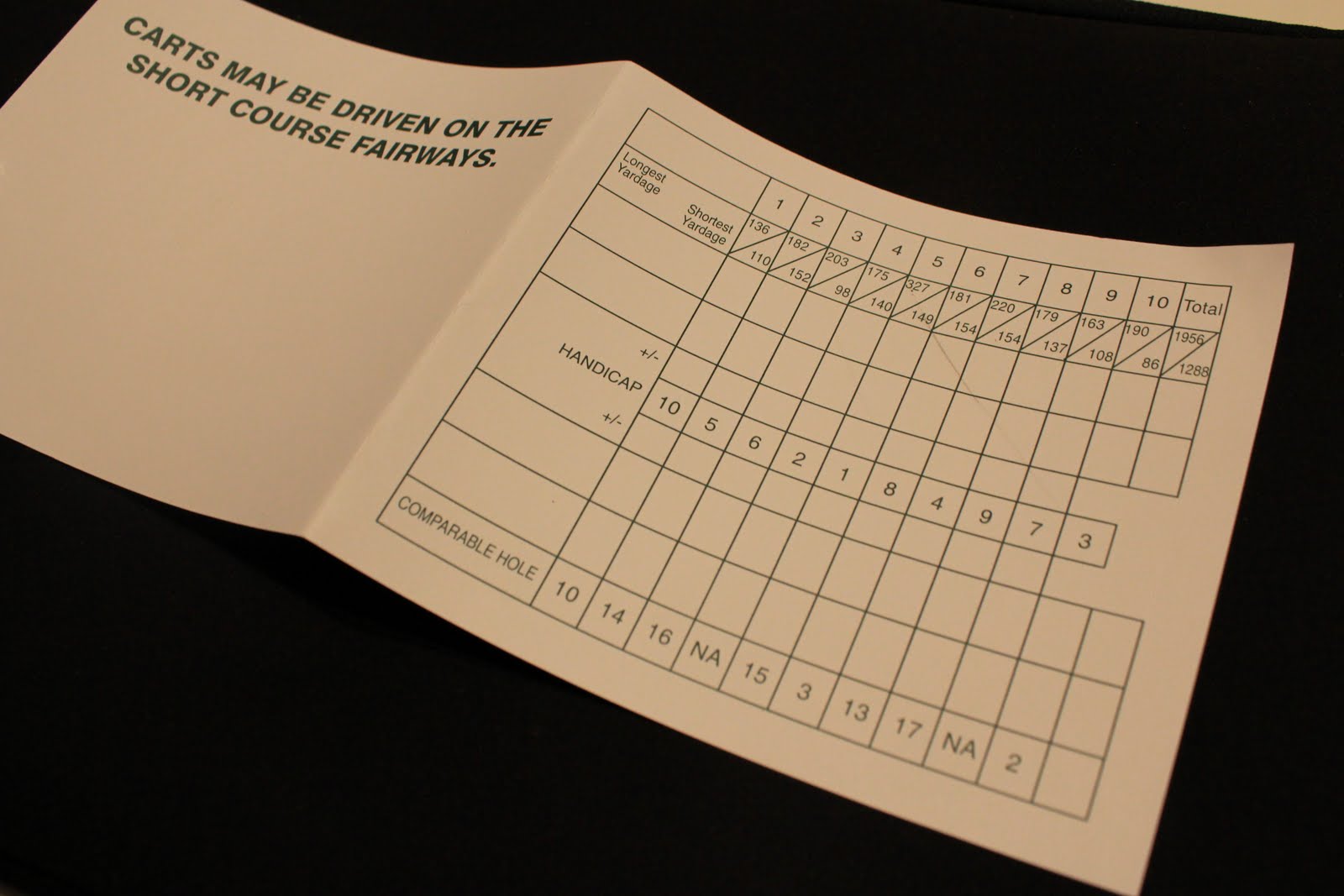
The Short Course at Pine Valley was built in 1992 and it consists of ten holes, eight of which are based off holes on the big course (2, 3, 10, 13, 14, 15, 16, and 17 are copied). These holes replicate approach shots a golfer would find on the Big Course. The other two holes are original designs: one done by Tom Fazio (a Pine Valley club member) and the other done by a member named Ernie Ransome, who originally developed the idea for the Short Course. Ransome, an involved member for over 50 years, served as club president from 1977 until 1988. The Short Course has its own head greens keeper and is in perfect shape, just like the big course.
Only a few of the copied holes are identical. One nearly identical hole is the first hole, which is modeled off the tenth hole on the big course. The elevation change from the tee to green is within a foot of the full tenth hole. Ransome was quoted saying, “I always said I would never build a second course at Pine Valley to compete with the original, but I did get the idea of doing this, and thought it would be nice to duplicate some of the original holes. Tom took it from there and did a wonderful job.” Ransome’s idea was to offer the members a way to practice approach shots that could be found on the course in a competitive and interesting manner.

Playing the Short Course was an almost eerie experience on account of how closely certain holes matched their original course counterparts. While standing on the green of the hole copying the 13th, I noticed that everything in my view matched the same hole on the big course, including the positioning and species of the trees lining the fairway. The Short course was the cherry on top of an amazing day. I appreciated the member taking the time to play the course with me as well as sharing a lot of Pine Valley history.
Ransome followed the legendary John Arthur Brown as president, the member who ruled the club for half a century as a dictator-type figure. Brown ran Pine Valley in much the same fashion Clifford Roberts ran Augusta National: a committee of one. Ransome has a scholarship established for students attending the University of St Andrews. Based on his amazing golfing knowledge and connection to my University, he is a favorite of mine!
I don’t know how many more times I will be able to play Pine Valley. If I never play it again, my only round there will have been incredible and nearly perfect. The entire experience was something I’ll never forget and if I ever go back, I doubt the greatness will have changed one bit.