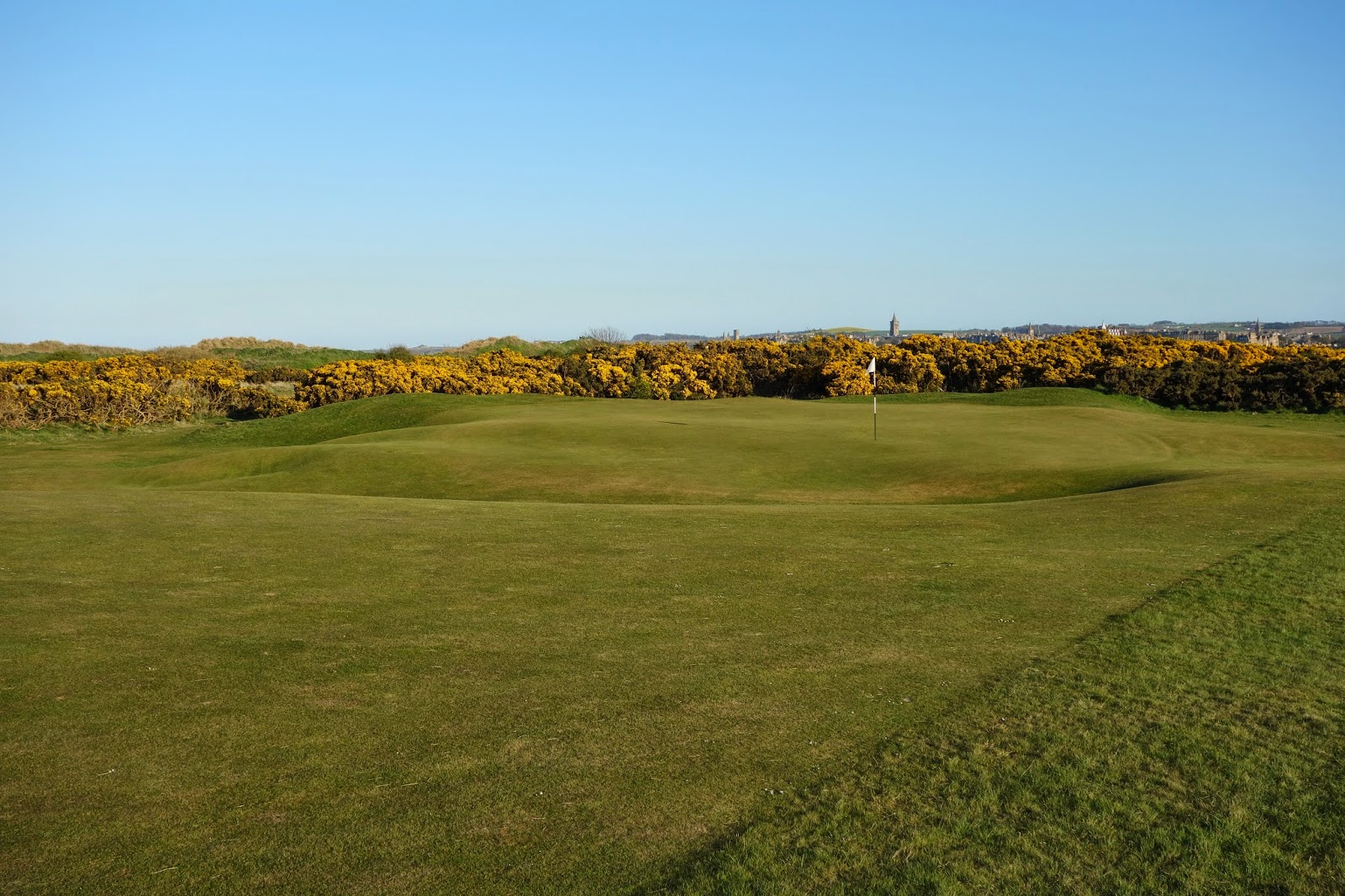
The St Andrews New Course holds a special place in my golfing heart. It was where I played my first round in St Andrews, and I cut my links golf teeth over its slopes and bunkers. A typically fast pace of play, first-come, first-served tee time system, and very enjoyable course design have made the New a favorite of many local golfers. If the New Course was located elsewhere along the Scottish coast, it would undoubtedly be ranked highly in its own right. Instead, the course lives beneath the Old Course shadow, and many golfers don't give the New the credit it deserves.

The New Course was commissioned by the Royal & Ancient Golf Club of St Andrews to be built by Old Tom Morris in 1895. Through the payment for the New Course, the R&A secured allocated Old Course tee times, which are still in effect to this day. The New acted as a second golf offering in the small town, alleviating crowding on the Old Course. Old Tom laid out the course in a traditional "out and back" links routing, which takes advantage of the natural terrain of the land.
The New Course lacks a certain "wow" factor that is found on other seaside links, but it offers a very solid links design that tests all aspects of the game. The New Course has smaller and more defined fairways than the Old Course. The bunkers are fewer and shallower than those found on its older brother, but they still offer a great challenge. Many of the University of St Andrews Golf Team matches are played over the New Course. It would be a real disappointment to visit St Andrews and not play the New.
 |
| Click on any photos to enlarge |
I find myself drawing comparisons to the Old Course, but I encourage visiting golfers to play the New Course, and try to view the course outside of the setting provided by the other six St Andrews courses. If you have played the New Course on a golf trip to St Andrews before, leave a comment with your thoughts below this post!
Hole #1 - 336 yards
The opening two holes of the New Course are very similar. After straightforward tee shots, large flat greens are guarded by single bunkers on the front right. A smaller bunker also guards the back left of the first green.
Hole #3 - 511 yards
The par 5 3rd hole is a dogleg left, with a number of large bunkers down the left hand side. During the summer months, the right hand rough is very thick, and an accurate drive is crucial.
The green is slightly raised, and the back falls off into thick grass before running into gorse. No bunkers guard this green, although it is by no means easy when the rough is in summer thickness.
Hole #4 - 369 yards
The 4th hole is another dogleg left, requiring a 3-wood or long iron off the tee for accuracy. The photo above, taken at the bend of the dogleg, shows the approach from 150 yards.
The green complex on the 4th is particularly interesting, with three bunkers guarding the front left. The putting surface itself slopes from front to back, and balls landing well onto the green commonly run over into the gorse behind. The best play is to land short and run the ball down the slope.
Hole #5 - 180 yards
The par 3 5th is a particularly challenging hole with a slightly raised green that slopes from front to back. Two deep bunkers guard either side of the green and a unique bowl is carved out of the center, creating a horseshoe shape. The hole was once framed nicely by gorse behind the green, but in the last two years, the gorse has been removed and sand has been moved in to create an artificial dune. The mounding looks very unnatural, and is clearly man-made to separate the New and Old courses.
Hole #6 - 445 yards
The 6th hole is considered by many to be one of the hardest in all of St Andrews. The tee shot is particularly tough, with gorse down the left side of the hole, and a mixture of thick grass, heather, and gorse roots down the right.
The long approach shot is no easier than the tee shot, with a large swale in front of the heavily sloping raised green. Accuracy is a must, as up and downs are rare around this green.
Hole #8 - 481 yards
The 8th is another dogleg left par 5. A set of cross bunkers, seen in the photo above, guard drives over 280 yards. The approach to the green must be threaded in between a set of spectacle bunkers, which sit on dunes either side of the green entrance. This is one of the approach shots that you will remember long after your round.
Hole #9 - 225 yards
The 9th is one of the most picturesque holes on the course. The long par 3 is bordered by OB and the Eden estuary on one side, and thick grass on the other. The green is sunk and shaped like a bowl. A running shot that merely trickles onto the green is the best play on this tough one shotter.
Hole #10 - 464 yards
The 10th hole is one of the best on the course. The blind tee shot is challenging, and a long approach to a great bunker-less green creates a memorable hole. The 10th has been listed for years among the 500 best holes in the UK, and Bernard Darwin gave it a special mention in his 1910 book,
The Golf Courses of the British Isles.
Hole #13 - 157 yards
The 13th is another great one shot hole on the New Course. The raised green is guarded by three bunkers and it slopes heavily back to front. Club choice is vital, as anything short will roll back twenty yards short of the green.
Hole #15 - 394 yards
The green on the par 4 15th is offset to the right of the fairway. After a straightforward tee shot, approach shots are more challenging. Large slopes, odd angles, and bunkers all guard the green. Aim right of the pin, and focus on distance control on the 15th.
Hole #16 - 431
The 16th fairway has some of the most undulation that you will find in St Andrews. The slopes aren't massive, but they affect stance on nearly every shot. During summer, thick rough borders both sides of this fairway.
Hole #17 - 229 yards
The 17th is the final of four great par 3 holes on the New Course. A bunker in line with the center of the green, but well short, provides visual intimidation, and appears to be blocking any running shots from the tee. A bunker on the right is not very deep, and is a decent place to miss a tee shot. The photo above was taken 180 yards from the green.
Hole #18 - 408 yards
The 18th hole requires a straight drive and solid approach shot. The Links Clubhouse frames the left side of the green, and a deep bunker guards front right. Beware of OB directly over the back of the green, which comes into play during firm playing conditions in the summer months.
The St Andrews New Course does not get the credit it deserves. I hope that this post has encouraged you to play the New on any future visits to St Andrews. The round will test every facet of your game, and if you score well on the New, you'll be able to take on any of the other six links.