Showing posts with label Scottish Golf Trip. Show all posts

Tuesday, March 11, 2014

North Berwick (West Links)

North Berwick is one of the genuinely fun golf courses of Scotland. Ancient stone walls dissect many of the holes, exposed rock surfaces on a number of the fairways, and stunning views frame large sections of the course. The town of North Berwick is charming in its own right, and the locals become part of the experience as they spill across the golf course onto the adjacent beaches. The experience of playing North Berwick is very memorable, and because of this, it has gained a cult following among many of the better travelled golfers in the world. It is rare to find a knowledgable golfer who doesn't love the quirkiness and design of North Berwick.
North Berwick Golf Club clubhouse
Four golf clubs play their golf over the North Berwick West Links, but it is North Berwick Golf Club that manages the course and serves as the major club in the area. I have been treated incredibly well every time that I have visited North Berwick Golf Club. A sign outside of the clubhouse reads, "Your green fee ticket entitles you to temporary membership of the North Berwick Golf Club where you will be made welcome by the members." The membership and staff take on this creed wholeheartedly, making guests feel genuinely welcomed and at ease.  
The famous painting "Golf At North Berwick" by Sir Francis Grant
The North Berwick West Links are filled with character and exemplify the story of many historic Scottish golf courses. Organized play began on the links in 1832 with a course comprised of six holes. Land was acquired from one of the members in 1868 to extend the course to nine holes, with one of the new holes being the famed Redan. Course development then escalated with the same family allowing nine new holes to be built on their land, expanding the layout to eighteen holes. Many of those eighteen holes were very short, and a final expansion in 1895 gathered enough land for a course of respectable length. Ben Sayers oversaw routing changes in 1932 that established the layout seen today, albeit with minor changes. This amalgamation of design changes and course growth created something a modern course designer simply cannot replicate.

Hole #1 - 312 yards - "Point Garry (out)"
Picture taken from the back of the raised first green

The start to the round immediately alerts golfers to the quirky and unique course that lies ahead. The blind green is marked by the white pole in the distance, and a long iron off the tee sets up an approach from the area of the exposed rock on the left. The beach runs down the right side of the hole and is in play as a large hazard. The green, also seen above, is deceptively large and offers an excellent view of the beach and the Bass Rock in the distance.

Hole #2 - 414 yards - "Sea"
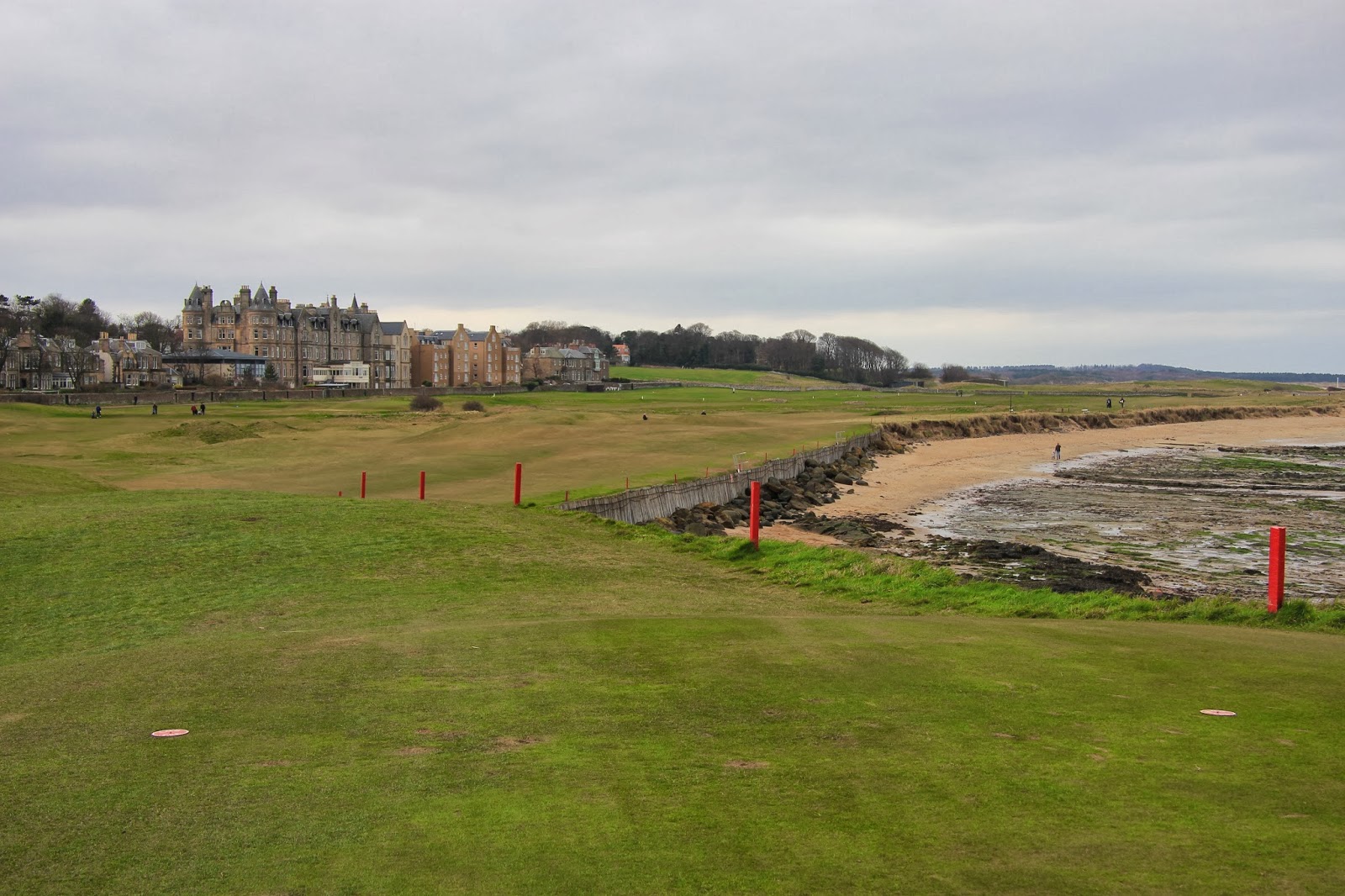
The 2nd hole hugs the beach and the white flag can be seen in the distance once the photo is enlarged (click on photo). Golfers can bite off as much hazard as they dare, but hearing the waves crash next to the tee subconsciously moves the aiming point further and further left.

Hole #3 - 460 yards - "Trap"
The approach shot on the 3rd hole is the golfer's first introduction to the ancient stone walls criss-crossing the course. Strategy is affected as longer golfers can get fairly close to the wall with their tee shot and the wall can be difficult to clear off the tight links turf. The wall is approximately 155 yards from the green, so laying well back from the wall leaves a lengthy approach.

Hole #4 - 168 yards - "Carlekemp"

This par 3 becomes even more difficult when heavy summer rough surrounds the green. The green complex is particularly interesting with an open entrance and well bunkered left and right sides. Because the putting surface is so narrow, a very accurate tee shot is required to hit in this green in regulation.

Hole #6 - 139 yards - "Quarry"
The 6th is another strong one shot hole at North Berwick. A valley, or old quarry of sorts, lies between the tee and green with a deep bunker sitting at the bottom. The green is very large, and with the wind into our faces during our round, I hit my 175 club into this back pin.

Hole #7 - 344 yards - "Eil Burn"
Longer hitters should be aware of this tee shot during the summer months. Long running shots can end up in the burn, which is just short of the green. I found this out during my first round at North Berwick, when I ripped a drive down the center and found my ball swimming in the burn. The best play is to lay back on this hole, leaving a full club into the green rather than a half shot flirting with the burn.

Hole #9 - 502 yards - "Mizzentop"
The angle from which I took this photo does not portray the sharp dogleg left shape of this hole. Two bunkers guard the inside of the dogleg and deter longer hitters from attempting to cut off the corner. The raised green is heavily bunkered, but a backstop saves longer approach shots from running over the green. These holes at the turn were part of the later expansions on the course, and I really like them. That being said, they have different character from the original sections of the course. More specifically, holes 6-12 have a different, but not necessarily weaker, feel than the rest of the course.

Hole #10 - 153 yards - "Eastward Ho" 

The downhill approach shot to this well bunkered green leaves golfers particularly exposed to the wind. This is another great par 3 green complex at North Berwick. Although it was not initially apparent to any of the golfers in our group, the putting surface slopes from right to left. This heavy slope, disguised partly due to the raised green and bunkers, caused misreads and three putts in our group.

Hole #13 - 362 yards - "Pit"
Looking forward while approaching the green
Looking backwards from the green towards the tee
The 13th is one of the most famous holes at North Berwick and is certainly one of the most photographed. One of the course's many stone walls runs directly in front of the green, cutting off the fairway from the putting surface. The green is sunk, and a large dune frames the back of the green. This is one of the most distinctive holes on the course. A modern course could never get away with having a wall directly in front of the green. There is a real urge to drop a handful of balls and practice approach shots to this green while standing in the fairway.

Hole #14 - 358 yards - "Perfection"


The 14th is said to have been named "Perfection" because it required two perfect shots to hit the green. With modern club and ball technology, the hole has become quite short, but two good shots are still required to hit this green. Bunkers stand in the fairway about 225 yards from tee, and a 135 yard approach is left in from that point. After hitting your approach shot at the white marker post, an amazing view is found at the top of the hill looking down at the green and the Firth of Forth beyond. In firm and fast conditions, a running ball landing short of the green is the best play.

Hole #15 - 178 yards - "Redan"


The Redan hole is the last par 3 on the course. The hole is famously the most replicated hole in golf course architecture. A large number of the top 100 golf courses in the world feature a Redan hole, but the original stands alone. The Redan hole features a green that slopes from right to left and away from the player. Landing a shot on this raised right hand side will propel a ball down and left towards the heart of the green. Bunkers can be found short of the green and off the lefthand side of the green. There are many ways to play the Redan hole, depending on the pin position, which is one reason that it is such a great design. Once you begin to look for Redan layouts, you begin to see them on many of the great courses of the world.

Hole #16 - 360 yards - "Gate"
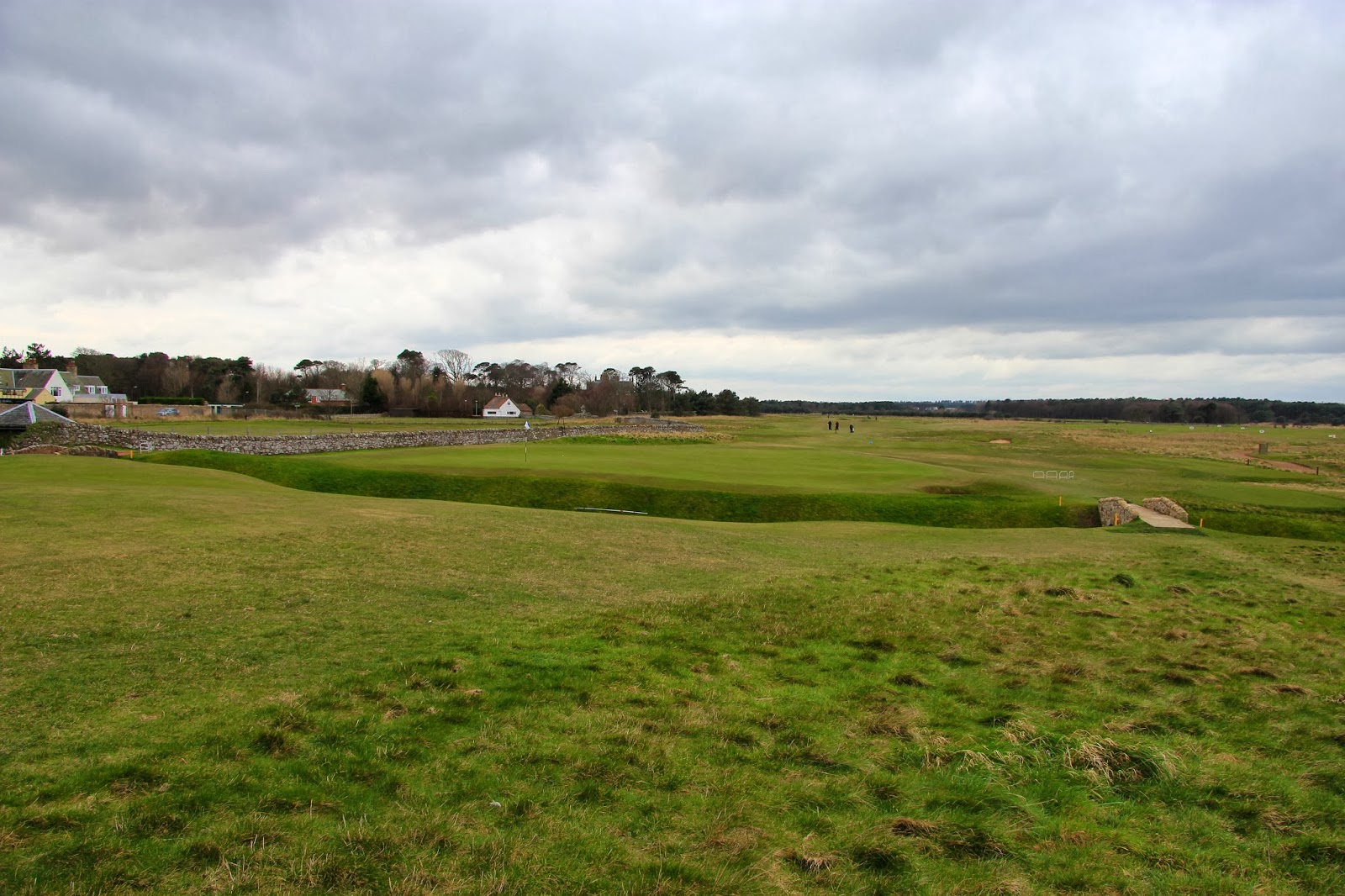
The green at the 16th hole is the most unique green on the course. It is made up of two islands, with a massive trench dividing them. The photo above is taken from the rear island, and the pin can be seen on the front portion of the green. Both of the putting areas on this green are very small, and it is difficult to hold approach shots anywhere near the pin. The trench dividing the two sections of green is nearly four feet below the higher levels of the putting surface.

Hole #17 - 405 yards - "Point Garry (in)"


The 17th is a fairly nondescript tee shot with the correct line being the Bass Rock seen in the distance. A single fairway bunker guards the landing area from which the blind approach shot is struck towards the large green. The red flag seen on the horizon line in the top photo is the 17th flag. The green is a bowl shape, sloping heavily from back to front and running off on the left side. Excellent views can be seen from this raised green.

Hole #18 - 269 yards - "Home"
Berwick Law, an ancient volcanic plug, dominates the skyline.
Some write off the finishing hole of the course as weak and short, but I find it to be part of the charm of North Berwick. It is reminiscent of the St Andrews Old Course's finishing hole, with cars lining the right side, clubhouse in the background, and a "valley of sin" guarding the front of the green. The hole is certainly a birdie opportunity for longer golfers. Interestingly, visiting golfers are issued a card with the club's insurance details to produce when they hit the cars lining the fairway. Thankfully our group went damage free on the last hole.

You're covered if you take out a windshield with a drive on the 18th
The recognizable Bass Rock off the coast at North Berwick
Many golf writers and other members of the media played North Berwick while visiting the 2013 Open Championship at Muirfield. The response to the course was overwhelmingly positive, and their reviews and photos added to the following that North Berwick has gathered over the years. There are a number of unique Scottish courses that fall into a similar category as North Berwick, most notably Cruden Bay and Prestwick. These courses will not be hosting the next Open Championship, but after playing most of the great links courses of Scotland, my rounds at these unique courses stand out as some of the most memorable. 

Wednesday, January 29, 2014

Perfect St Andrews Golf Trip - Where to Play

This post is part one of a three part series on where to play golf, eat, and stay during a golf trip to St Andrews, Scotland. I have been asked innumerable questions regarding these topics during my time living in St Andrews. This post will hopefully answer most of the questions existing about where to play golf while visiting St Andrews. If there are any others, please comment below!

The perfect first golf trip to Scotland uses St Andrews as a base of operations. Settle down into one of the many lodging options in town (to be discussed in a later post) and make day trips out from St Andrews to visit courses. I have witnessed, and participated in, many golf trips where people play 36 holes per day, staying in a different town every night while trying to see every course in Scotland. I have personally played 14 courses in 8 days all across Scotland without a car. I can tell you from experience that this trip plan is exhausting, and, when all is said and done, every course is a blur. Staying in St Andrews allows for relaxing nights, no commutes, and some of the best golf in Scotland on your doorstep.
I recommend staying between one week to 10 days in St Andrews. There are nearly 20 courses within an hour and a half drive that are worth a visit. The courses mentioned below are "must-haves" on any good Scottish golf itinerary. Make sure to follow the links to full course reviews.

St Andrews New or Jubilee
You may be arriving in St Andrews tired or jet lagged. After initially getting your bearings, play the St Andrews New or Jubilee courses. Both of these links courses are underrated and don't get the credit they deserve because they live under the shadow of the Old Course. The greens on the New and Jubilee are typically faster than the Old Course. A round on either of these courses will prepare you for the many rounds of links golf ahead. Full reviews of these courses can be found here.

St Andrews Old Course
Many people leave the St Andrews Old Course for the last day on their itinerary in an attempt to "end the trip with a bang." I cannot tell you how many people I have seen postpone the Old round until the last day, not get a tee time through the ballot, and go home disappointed. Play the Old Course early, and then try to play it again later in the trip. The Old Course is not visually stunning and the true genius of the course will not reveal itself in two rounds, but play it twice and you might get a glimpse of why it is top 5 in the world. If you don't get in for a second round via the ballot, play the Castle Course. My post on how to get a tee time on the Old can be found here and my review of the Old Course itself can be reached here.

Crail (Balcomie)
Crail Golf Links is a short drive from St Andrews and is one of the oldest golf clubs in the world. The Balcomie links offers a great design, amazing views, and a fun par 68 layout. A round at Balcomie will help you get in touch with what Scottish links golf is truly about. Absorb all the history and local flavor when visiting Crail. A round on one of these lesser known links courses is worth considerably more in its golfing weight than one of the many resort type courses. A full review of Crail (Balcomie) can be found here. I recommend a pint in the clubhouse and a bite to eat at the Crail Golf Hotel in the town proper after the round.

North Berwick 
North "Berrick" West Links can be found in an area of Scotland known as East Lothian, which is about an hour and a half drive from St Andrews. An entire week could be spent in the area taking in all the great golf on offer. Rounds at Gullane and Muirfield should also be on any East Lothian list. North Berwick is packed with history and is a course design nerd's heaven. The original Redan hole can be found on the course. It truly is a fun round of golf. A detail lacking course review can be found here. I plan on writing a new review ASAP with greater detail of the course.

Elie (Golf Club House)
Elie falls into a similar category to Crail (Balcomie), although Elie's course is undeniably stronger. A true links golf enthusiast needs to play a round of golf at Elie. The ambience, history, and views at the course are spectacular. Make sure to wander around the town and have dinner at the Ship Inn before driving back to St Andrews for the night. A full review of the course can be found here.

St Andrews Castle Course
I suggest using this day to enter the Old Course ballot for a second (or first) round. If you do not get a tee time, play the Castle! The Castle Course has come under fire for having extremely difficult greens, blind shots, and a difficult to walk terrain. All of those accusations are true, but if you enter the round without a scorecard, with a good attitude, and with your camera, you'll leave very happy. Have a look at the full course review here, and tell me those views aren't unbeatable. Enjoy a pint overlooking the course and sea in the Castle Course clubhouse after the round.

Kingsbarns Golf Links
I can't think of a more picturesque and enjoyable way to finish a Scottish golf trip. Kingsbarns is a great design with amazing facilities and better views. I have played Kingsbarns many times and caddied two seasons at the course. The only negative of the course is the ever climbing greens fee rate, which is now £200+ per person. The full course review can be found here.

After playing these courses during your St Andrews golf trip, come back to Scotland again. Next time spend 3-4 days in Ayrshire playing Turnberry, Royal Troon, and Prestwick. Head north after seeing the west coast and spend 3-4 days in Dornoch, playing Royal Dornoch, Brora, Nairn and Castle Stuart.

If you have any questions about planning a Scottish golf trip, leave me a comment or an email at livingasalinksgolfer@gmail.com. The next two posts in this series will be about where to stay in St Andrews and where to eat and drink. Keep an eye out over the next two weeks!

Monday, April 29, 2013

St Andrews Castle Course

The St Andrews Castle Course draws mixed reactions from those who have played the course. David Kidd designed the Castle, which opened in 2008. The course is set just outside of St Andrews, a short eight-minute drive south down the coast towards Crail.
The views at the course are second to none. The sea is visible from nearly every hole, and certain holes bordering the cliffs are literally breathtaking.
My main point of contention with the Castle Course is its greens. Since the course was built, the greens have been “redesigned” (read flattened) four times. Even with all the tempering, the greens are still extreme. The severity of the slopes limit pin placements, and during strong winds, certain greens border unplayable.
The crazy greens begin on the 2nd hole where, depending on the wind, approach shots can vary between 130-200 yards. The green has a massive false front, a large valley running through the middle, and severely slopes falling off the back into tall grass. It is simply unfair. The pin placement pictured is one of the few accessible pins. Aiming center of the green and hoping to end up in the valley is a player's best option. 
The two photos above are of the par 3 3rd hole. The lower photo is of the collection area behind the green. It is a two level green, with a large false front and a large collection area behind the green. The hole is 179 yards from the standard tees and the prevailing wind is behind the player. If the wind is even slightly strong, it becomes close to impossible to hold this green. 
The 4th and 5th holes are both par 5s at the Castle Course and both have horrendously difficult greens. The green pictured above is the fifth. The slopes are so severe and numerous that there are roughly only three usable pin positions depending on green speeds.
The 11th hole is an uphill par 4 to yet another sloping green. If the greens are running fast, there are only two useable pin positions, one of which is where the pin is placed in this photo. A large slope on the back of the green acts as a very useful backstop. A large false front forces any short approach shots thirty yards backwards off the front of the green. 
I consider the 12th hole to be the hardest hole on the golf course. From the medal tees, the hole plays 454 yards uphill with a prevailing headwind. The picture above shows the uphill approach shot to the green. Thankfully, Kidd had the sense to make this green large and not unreasonably difficult. The card shows the hole as stroke index 8 - very debatable....
The approach to the 16th hole can be intimidating. The green contains a valley and features yet another massive false front. Anything short of the pin runs back into the massive valley in front of the green. As is the theme with many of the Castle greens, aim for the center of the green and settle for the 25 foot putt.
The 17th hole at the Castle Course is the signature hole. It is a 174 yard par four over a large gully. At high tide the waves are crashing below the tee. The view is breathtaking! It is one of my favorite par 3s in the World. A large slope left of the green feeds balls down to the pin. Smart players utilize this slope depending on the pin placement. 
The 18th is a dogleg right par 5 with a massive shared double green. It is a compelling final view. The green is difficult, but fair. The approach shot into the tough green requires distance control and accuracy - something that should be found on a risk/reward par 5.

You may have seen a theme in this blog post of tremendously difficult greens and massive false fronts. Now, think on the topic again factoring in that the greens have been tempered and flattened four times since they were built. I would recommend playing the Castle Course to anyone visiting St Andrews, but leave the scorecard in the bag and keep the camera out. 

Thursday, January 31, 2013

What is a Links Golf Course?

 The question of “What is a links golf course?” has been posed to me countless times during my time in St Andrews. After a round on the St Andrews Old Course yesterday in 45MPH+ winds, I felt inspired to write a definitive answer to this repeated question. In addition to answering the question of what technically makes a links course, I also aim to explain the mindset that accompanies a pure links experience.

North Berwick, East Lothian, Scotland
In the most basic sense, the land upon which it is built defines a links golf course. Robert Price wrote in his book Scotland’s Golf Courses, “Scottish links land occupies a relatively narrow zone (often less than one mile wide) along the coast. Since the source of the sand is the adjoining beach and the mode of transport is on-shore winds, the distance the sand extends inland is not great. It tends to accumulate in dune ridges, which are usually ten to thirty feet high, and, on average, rarely occur higher than seventy-five feet above the present sea level... The fairways are found on the short grass of the inter-dune system while the dune ridges and their tough marram grass form areas of “rough.”
Askernish Golf Club, South Uist, Outer Hebrides, Scotland
Simply put, a links course is built at sea level, in the sandy dunes (or linksland) that run parallel to the beach at sea level. The sandy soil conditions lend to very firm, fast conditions requiring a plethora of shots not found anywhere else. After reading this definition, a number of links course imposters will immediately come to mind. “Links style” is completely different from a true links course.
Royal Aberdeen Balgownie Links, Aberdeenshire, Scotland
Additionally, there are a number of other factors that accompany a links golf experience. Lorne Rubenstein wrote in A Season in Dornoch, “Golf on a Scottish links consists of enduring and even welcoming the conditions, allowing them to influence the shots one plays. To play links golf is to acknowledge that nature, not the golfer, dictates play.” Wind and rain are the true defenses of a links golf course. As the Scots say, “Ney wind, ney rain, ney golf.”
Machrihanish Links, Mull of Kintyre, Scotland
Playing a true old Scottish links encompasses so much more than merely the style of the design and the proximity to the sea. It is the respect for the game in its simplest form, the abandonment of scorecards, walking with no carts, and the lack of commercialism, which among many factors, make it so special.
Cruden Bay Golf Club, Aberdeenshire, Scotland
Many of Scotland’s great links are succumbing to decisions made in the corporate boardroom. Such decisions may not affect the quality of the courses, but they can have significant impact on the aforementioned factors that make these links courses unique. On a golf trip to Scotland, play the great resort courses, but do your best to play at least one hidden course. Get the true taste of Scottish links. Go find a course with an honesty box – a box on the first tee in which you are to deposit your small green fee due to the absence of staff or clubhouse.
"Honesty slot" at the trailer clubhouse of Askernish Golf Club, South Uist, Scotland
Famous golf writer George Peper sums up this idea so well in his quote spoken to the Fife Golf Association; “Someday I hope to bring my grandchildren here to Scotland – not to show them what golf is but what golf isn’t – that it isn’t $200 million resorts and $200,000 membership fees, that it isn’t six hour rounds and three day member-guests, that it isn’t motorized buggies, Cuban cigars, and cashmere headcovers. It’s a game you play simply and honorably, without delay or complaint – where you respect your companions, respect the rules, and respect the ground you walk on. Where on the 18th green you remove your cap and shake hands, maybe just a little humbler and a little wiser than when you began.”