Tuesday, September 11, 2012

Harbour Town Golf Links


The decision to play Harbour Town was last minute. We were driving from Savannah, Georgia to Augusta when my girlfriend, Isla suggested a detour to Hilton Head Island. As we got closer to the Hilton Head, I figured a call to see if Harbour Town could work out a single might be worth a shot. A few minutes later, I was booked to join a threesome at 2:10.
Admittedly, my knowledge of Harbour Town didn’t extend far past its world ranking, course designer, and what I had seen on TV. I was planning on comparing the course to Kiawah Island’s Ocean Course, but I found a unique course with a set of challenges not often seen on the PGA Tour. Harbour Town is considerably shorter than most modern PGA venues. Bunkering, narrow fairways, small greens, and a premium on placement create the challenge.
Harbour Town's scorecard is a beautiful painting
The fourth hole, pictured below, is a 165 yard par 3 with water wrapping around the entire green, except for a bail out area to the right of the green. The pin was tucked into a back right portion of the green. While very visually intimidating, this green is larger than others, helping players with the difficult shot.
The fifth hole was a beautiful dog leg left par 5. Having never seen the hole, the tee shot looks fairly unassuming and straightforward (as seen in the below picture). Once at the bend in the dog leg, bunkers and a lake are revealed on the left with trees and green-side bunkers on the right.
5th tee shot
View from the bend in the dogleg 
The ninth hole is a very short par 4 that requires an accurate tee shot. A group of trees narrow the fairway 50 yards short of the green. The green is drastically horse shoe shaped, and, depending on the pin position, left or right can be completely blocked out. The large clubhouse backs the ninth green.
Back left pin position on the horse shoe shaped green
 The front nine at Harbour Town were solid, but fairly lackluster. In the words of our forecaddie, Derek, “The course really comes alive after the 12th hole.”

One of the weakest and most "tricked up" holes on the course came at the 13th. The front of the green is guarded with 5 foot high railroad ties. According to our forecaddie, the hole was designed by Ellis Dye, Pete Dye's wife. She is also said to have had a hand in the 17th hole at TPC Sawgrass, another ridiculous hole.
Click on the picture to see more detail of the green complex 
One of my complaints about the course was a lack in variety with the par 3s. The 14th hole was a reverse of the 4th, with the water being on the right instead of the left. The 7th hole was very similar to these aforementioned par 3s, but was merely surrounded by sand instead of water.
The 17th hole, seen below, was one of the more challenging holes on the course. It is a long par 3 with an alarmingly small green. If players aren't intimidated by the water on the left, bunkers guard the left and right sides of the green. 
 The famous view up the 18th is striking in person. The fairway is extremely wide, but the green is very small (see a theme?).
Harbour Town was a very enjoyable golf course. Nearly every hole is lined with condos and houses. Some people find this attractive, but personally, I felt it detracted from the course. 
I loved to see a design that, while short, can still provide a challenge for the pros. The course is 7,100 yards from the tips. The Ocean Course at Kiawah can be stretched to nearly 8,000 yards. Harbour Town shows its difficulty with tiny greens, narrow fairways, and great bunkering - more modern tour courses should take note.

*After 2:00PM, there is a large price cut in the greens fees at the course. If money is a concern and you don't mind the afternoon heat, play after 2PM!

Saturday, August 25, 2012

Life as a Caddy


I have spent this last summer caddying at Kingsbarns Golf Links. Over the course of the season, I have averaged five “bags” a week. I have caddied for everyone from CEOs and former European touring pros to people who have only been playing a few months.
Kingsbarns 3rd hole
Both through observation and direct advice, I learned a lot during the season of caddying. My own game’s course management has matured. My views on people and career options have changed and solidified. Unexpectedly, my opinions and thoughts on course design have changed.
I saw two handicappers shoot 90 and I saw “fourteen” handicappers shoot 73. I had golfers hand me three identical balls on the first hole and quietly say, “Make sure we never lose a ball.....” Always keep an eye on your playing partners!

Many setting out on their first UK golf trip have never had a caddy. Here are some advice and some thoughts on taking a caddy:

Should I get a caddy?
-A caddy can be indispensable when playing a course you have never seen. The sixty or seventy pounds you pay the caddy is easily worth the enjoyment of knowing where to hit the ball off the tee and having your putts read on unknown greens. If money is an issue, take a single forecaddie, who will give lines, yardages, and read putts for all the players in the group.
The 7th and 15th greens at Kingsbarns
He misread my putt!!!
-How often during a round do you make twenty-five foot putts? Even fifteen-foot putts? - Once or twice a round most likely. Having a caddy give you the line doesn’t magically improve putting skills. Further, the line of a putt can vary drastically depending on the speed with which the putt is struck. Meaning that your caddy can give you great lines all day, but if you hit the putts too hard or soft, they aren’t going to fall! I say this having witnessed golfers get angry with caddies for having “misread” putts that in reality were perfectly legitimate lines. All of this being said, nobody is infallible, and caddies do misread putts as well, just be careful to judge.
Kingbarns' 12th hole
How much should I pay?
-The standards for paying caddies can be confusing for people on their first trip. At Kingsbarns, the rate is 45 pounds plus gratuity. The suggested gratuity is ten pounds for “met expectations” and fifteen pounds and up for “exceeded expectations.” Most caddies that I talked to average around 67 pounds a bag during the season. In the UK, I would suggest paying a good caddy 60 pounds, and I would suggest paying a great caddy 70 or even more if your wallet allows. (Don't be afraid to pay a horrible caddy low numbers...)
Devilishly tricky par 3 13th
Enjoy it!
My most important piece of advice has to do with the overall enjoyment of the round. Kingsbarns is one of the most picturesque and beautiful courses that can be played in Scotland. I repeatedly caddied for people who were so caught up in their bets and scoring that they never looked up and took the time to realize just how lucky they were. They let scoring poorly or losing money completely ruin what otherwise could have been one of their most enjoyable rounds. I am the first to admit that golf can be the most frustrating and annoying thing in the world, but if you make it over here to Scotland to play, do your best to step back and as my dad would say, “enjoy the breeze!” 
Par 3 15th hole with a difficult forced carry over the water
Upcoming plans
At this point in the summer, I have stopped caddying and have just completed a short internship with Golf Monthly, the leading golf magazine in the UK. I learned about golf journalism gained general knowledge about the golf industry. Hopefully this will result in some positive changes to both the blog and my writing! Keep an eye on the blog for some exciting new course and equipment reviews!

Monday, July 30, 2012

Ireland Golf Trip

The 2012 Ireland Golf Trip was my first visit to Ireland, my first taste of Irish golf, and my first time experiencing the “package” golf trip. I was eager to compare the great Scottish courses to their Irish contemporaries. Our trip lasted one week and included six rounds of golf.
Those on the trip included my ever-present golf buddy Matt, his dad, and a group of his father’s friends (all of whom were from New Zealand). During the week, I experienced the New Zealander’s calming laid-back attitudes, along with their extreme generosity. A special thanks to Matt's dad Nick, who made the trip possible. 

Ardglass Golf Club
The trip began with a round in Northern Ireland at Ardglass Golf Club. Ardglass has a beautiful clubhouse that is part of an ancient castle. The first five holes on the course are stunning. The par-3 second was especially impressive with cliffs on the left and a forced carry of nearly 160 yards to reach the green. There was a noticeable lull in the quality of holes between the sixth and eleventh. This sag in remarkable holes left a slightly negative taste, but from the twelfth onward, the design regains form and finishes strong. The eighteenth provides a final chance for birdie with a beautiful elevated tee and a drivable green. If you are in the N. Ireland playing Royal County Down, I would strongly recommend making the effort to go play Ardglass.
Ardglass's practice putting green and clubhouse
Par 3 second with a large forced carry
Par 3 tenth hole with an elevated tee
Royal Portrush
Royal Portrush’s rating of fourteenth in the world speaks very strongly about the course. Our trip came to Portrush two weeks after the Irish Open. This meant that the greens were in excellent condition, but it also meant that much of the rough had been cut or trampled down by the galleries. This was great for me since my driver was slightly wild throughout the round! Very few weak holes could be found and my only complaint was the lackluster 18th hole. 
Well bunkered first hole with an elevated green
Fourth hole with OB tight right and bunkers down the left
Par 3 tenth hole with a mean pin placement... wind was strong off the right
Par 5 seventeenth with MASSIVE bunker short right off tee
Ballyliffin Old
When a course rater reviews a course, one of the criteria is “variety of the par fours.” This was one area where Ballyliffin’s Old Course was lacking. There was little variety between the par fours, and extremely high rough combined with strong winds made the day a grind. Upon finishing the round, none of us could recall a single hole we particularly liked (or even disliked!). The only hole that came to my mind was the par 3 sixth hole, which with its elevated green reminded me of the thirteenth hole at Muirfield. Nick Faldo had come in and redesigned (added a few bunkers) to a number of holes on the course along with completely redesigning one of the par 5s. None of the Faldo redesign holes were particularly interesting. We didn’t play the Ballyliffin Glashedy Links, but I hope it has a better selection of par 4’s. After looking through the photos from the day, none were especially interesting, which does speak to the quality of the course.  

Par 3 sixth with elevated green
Donegal
I would have greatly benefited from having played Donegal Golf Links prior to our round. Despite having a forecaddie for the group, multiple blind approach shots and blind tee shots led to bad results due to sheer ignorance about the layout. The par 3 fourth hole was extremely good. Bunkers left and high rough low right made the long par 3 challenging, but score-able. Donegal was an enjoyable course, but I wouldn't go out of my way to play it again. 
Beautiful par 3 fourth! Best hole on the course in my opinion
Par 5 eighth hole... After the drive it is an awkward approach to the green. Must have seen it before to score well!
Co. Sligo
County Sligo offered the best views of any course played on the trip. Beautiful mountains framed one side of the course with water and beaches lining the other side. A high, elevated third tee provides the best chance to take the great view in. The course was not excessively long, but required thought and well positioned shots. I would strongly suggest a round at Co. Sligo to any visiting golfers.
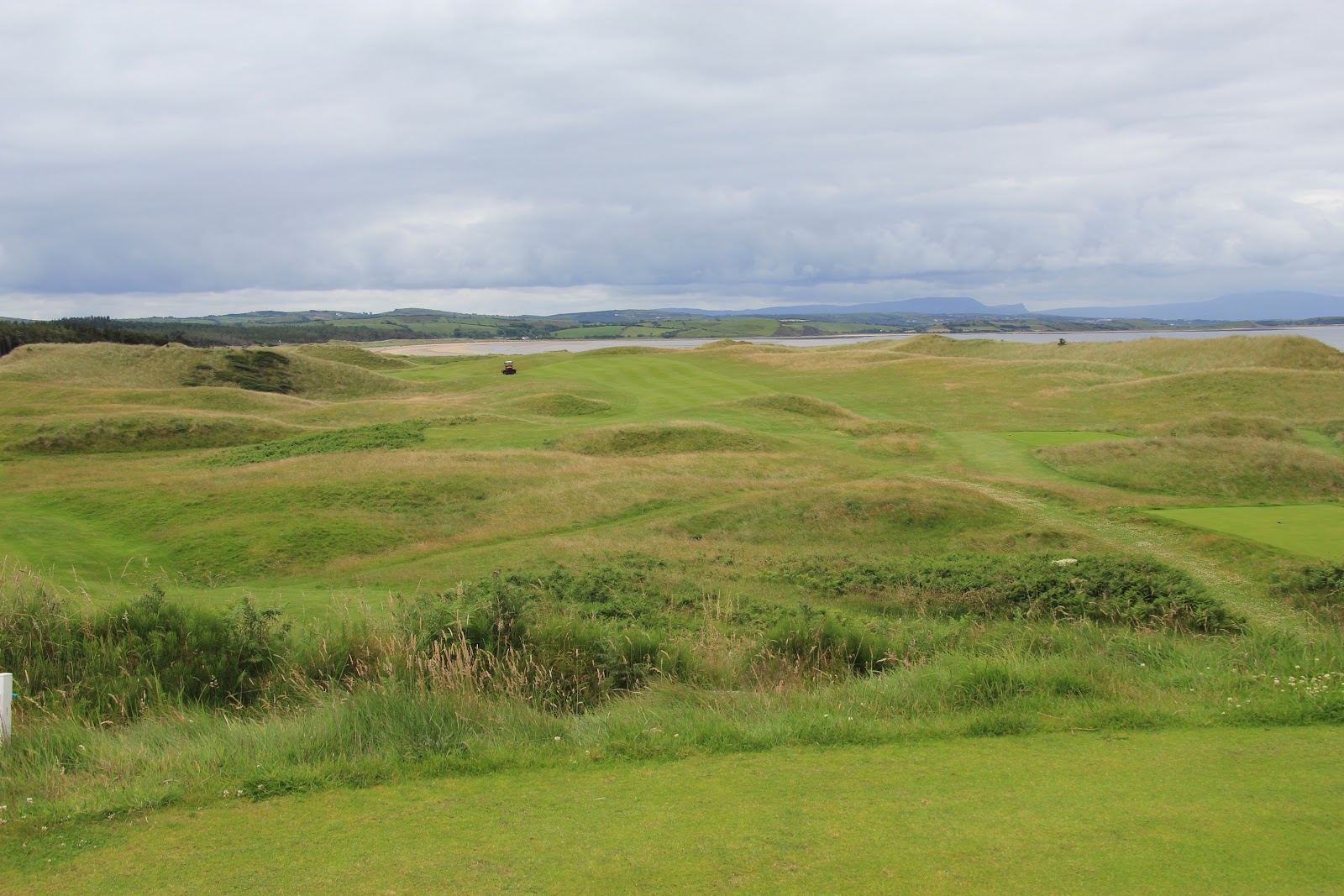
View from the elevated third tee box towards the water! (Mountains in the picture below were behind us)
Par 3 ninth hole with gorgeous mountains in the background

Seventeenth fairway hidden within the hillside
Enniscrone
Enniscrone was our last course and turned out to be the favorite of multiple people on the trip. Most of the holes are set within deep dunes, giving a secluded feeling on each hole. Six new holes were built ten years ago. Those six holes were extremely strong and took the course to the next level. Further, the six new holes were not uncharacteristic from the course and fit in well overall. My only complaint for the course was too many blind tee shots. Even with a caddie, I was confused on many tee boxes, and having seen the course before would have paid dividends. Unfortunately, I forgot my camera. Some of the holes were gorgeous, and you'll have to take my word that a visit is necessary! 

There are benefits to the “plan it yourself” golf trip, including freedom and flexibility. Having experienced both at this point, it is also very nice to be driven everywhere, have problems solved, and everything planned. If it is your first trip to the UK for golf, I would give serious to using a golf travel company (something I wouldn’t have said pre-Ireland...). I would recommend visiting Ardglass, Royal Portrush, Co. Sligo, and Enniscrone. We all had an excellent time, and I am already planning my next trip back to Ireland, particularly the southwest corner!

Wednesday, June 13, 2012

Royal Dornoch

Our trip to Royal Dornoch exemplified perfectly the difficulty of golf trips without a car. It was another trip with my good friend Matt, and it lived up to all expectations. We took multiple trains, which eventually dropped us in the very remote town of Tain, Scotland. From Tain, we took a bus to the town of Dornoch. We then found that Dornoch has no taxi companies, so we hopped a ride on a school bus to our B&B. Our journey had taken us deep into the Scottish highlands to play what is one of the best ancient links courses in Scotland. I had a personal goal of playing Dornoch, because it was the home course to Donald Ross, the course design master who brought the world Pinehurst #2, and my home club, Biltmore Forest Country Club, in addition to many other greats.
We played a twilight round the evening of our arrival. This allowed us to get a good look at the course before our early morning tee time, but also to slow down, and let everything sink in while the course was empty. The decision to play the twilight round was excellent. We made our scores irrelevant, and brought the design and course layout to the forefront. Between our two rounds played, we were able to grasp the course, and realize that it was one of the best ancient links in Scotland. As my dad would say, "We sat back and enjoyed the breeze!"
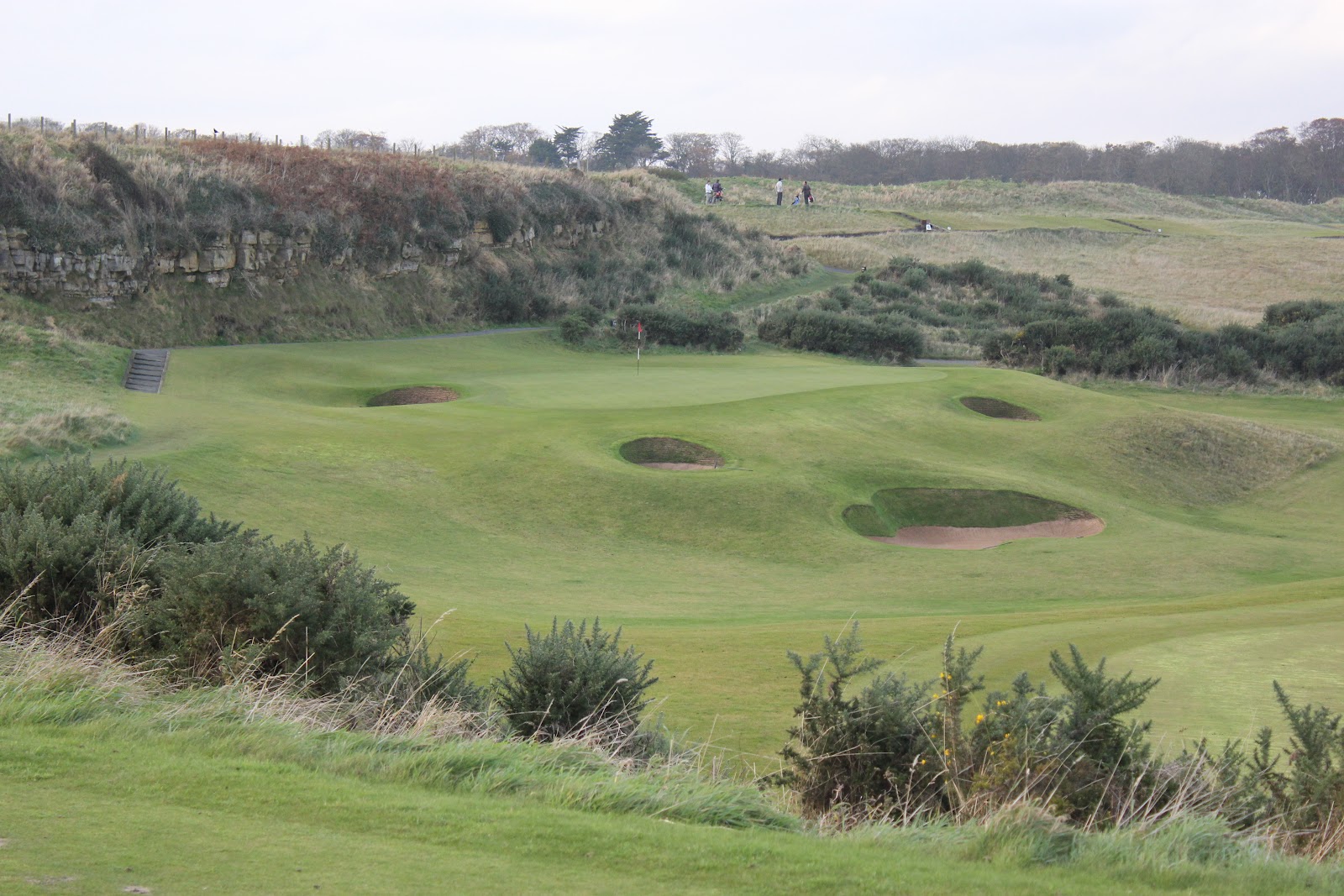
 The course begins to come alive on the par-3 second. It is a 175-yard hole with a raised green and severely sloping sides, both spilling into small collection areas. With green complexes like this one, it is easy to see where Donald Ross found his inspiration for Pinehurst #2. His signature small greens, with beautiful bunker complexes, definitely have their roots at Dornoch.
 The course dramatically opens up from the third tee onwards. The beautiful sunset during out twilight round was a perfect way to end the day. (This photo taken while walking to the 18th.)
The bunkering on the 5th hole is classic. With a set of bunkers guarding a right side bailout and three massive bunkers endangering huge hitters and short approaches, there is plenty to think about on the tee. Lots of room on the left side of this fairway makes it obvious that if played correctly, a good score can be had. Getting greedy or leaking the ball right would lead to big numbers.
 The 161 yard par-3 6th has a massive slope on the right side, and bunkers and gorse guarding the left. A confident tee shot is a must. This is one of the holes at Dornoch that is truly fun. We spent time chipping around and hitting multiple approaches into this small challenging green.
 This famous view at Royal Dornoch is from the 7th tee box looking back at the majority of the course. It was absolutely stunning.
The par-3s at Dornoch really stood out. This picture of the 10th green shows the clever green complex, with bunkers guarding nearly every miss, even over the green. The par 3s varied in length, with the longest reaching 175 yards. They were challenging and fun to play, while not presenting unenjoyably long beasts.
The finishing holes were strong, and the 17th was particularly fun to play. The 16th required a straight tee shot, which we found to be a theme on nearly every hole. A premium was put on straight drives, and long rough bordered by gorse was quick to catch any wayward balls. If you could drive the ball straight, you could go low. I had two eagles on the back nine during the twilight round (on 12 and 15), along with two double-bogeys (on 14 and 16), where I hit it in the gorse.
The course conditions were superb. Being a "golf nerd," I always look out for types of grass, and particularly the conditions of the greens. The greens had nearly no intruding grasses, poa annua, or other impurities. They rolled very true.

Unfortunately, we had a negative experience with the staff at Royal Dornoch. Due to our random assortment of trains and buses, we arrived for our 6:30 twilight round at 14:00, planning on slipping out early. After a massive meal in the clubhouse and an hour spent putting, we asked the pro at 16:30 if we could tee off early. The course was completely empty. He said that we were the next tee time, but if we wanted to go off early, we would have to pay 40 pounds each to upgrade from a twilight rate. I understand that rules are rules, but while we sat for two more hours, not a single person teed off. Letting two students off two hours early would not have hurt the club, and I wouldn’t be writing this negative blurb right now. The rude and illogical way they went about letting us tee off was a disappointment. It put a stain on what could have only added to the trip. Luckily, the great golf overshadowed the pro-shop staff.
In the category of "Old Scottish Links," Dornoch is unquestionably one of the best. It had the beautiful Old Tom Morris design elements of Machrihanish, with some of the fun of Cruden Bay. Golf was first played in Dornoch in 1616, and if it weren't so darn rural, it would get the same amount of play as Troon or other contemporaries. I don't know when the next time I play Dornoch will be, but I would recommend it to anyone who is willing to make the journey.

**I forgot to add one more comment on the course. On the negative side, the course had no yardage markers. There was a 200 yard stone and a 150 yard stone, but other than that, literally nothing. Without a range finder, many club choices and yardages had to be guessed. This was one of the only negatives of the golf course itself. 

Thursday, May 17, 2012

St Andrews Links - Behind the Scenes

If you have ever played at any of the St Andrews courses, thinking back on the round, did you see any greenskeepers? I seriously doubt it. The St Andrews Links hosts tens of thousands of rounds every year. Despite this huge number of rounds, the courses stay in incredible condition, and you never see work being done (other than the odd bunker re-build mid-winter). To give a unique look at the dedicated and unseen group who keeps the Links in such great condition, I interviewed Gordon Muir, the Director of Greenskeeping at St Andrews Links.

-How long have you been working at the St Andrews Links? 
I’ve been here almost 21 years. I started here in Sept 1991 as head greenkeeper on the Eden course and in October 2000 was promoted to my current position as Director of Greenkeeping.

-What previous positions did you hold before coming to St Andrews?
 I came up through the ranks at Fraserburgh Golf Club, a 27 hole members course in the NE of Scotland where I started as an apprentice and was head greenkeeper for 11 years before I left.

-How many greenskeepers does the links employ?
Around 50 full time employees plus 6 full time mechanics. From mid April until early October, we take on a further 20 students who are going through greenkeeper training/college or have worked on golf courses around the world and have some experience.


-How do you set up the courses to handle the massive numbers of rounds played?
We have enough staff to allow us to carry out 90% of the essential work before golf starts each morning, cutting most areas, setting the course up, moving holes etc. (Keep in mind the first tee times are at 6:30AM). The Old Course is closed on Sundays, during which we take advantage and bring a full team in to do things such as topdress the greens or anything else that would be disruptive to golf. We have what we call a “maintenance morning” on each of the other courses where greenkeepers have the right of way until 9am on one course/day. During the off-season we’re not as busy, and jobs such as aeration can be carried out.

-How often do bunkers need to be re-built? 
Depending on their location and how much traffic they get, they can last up to 6 or 7 years. Road hole bunker by the 17th green needs to have the face of the bunker replaced every year, but some of the small bunkers that are rarely visited can last 7 years easily.

Road Hole Bunker - www.weiunderpar.com
-How does typical course care differ from tournament course preparation (ie for the Dunhill or Open)? 
There is very little difference. When it comes to something like the Dunhill, we would cut all areas every day from a week beforehand whereas we would normally only cut tees, surrounds and fairways 2 or 3 times a week. Greens are cut every day anyway from April until October. Depending on weather and growth we might roll the greens more often during the period. It’s unlikely we would alter the height of cut but that would be growth dependent. We would have timed any topdressing or fertiliser applications so that they wouldn’t fall the week before the tournament and we wouldn’t aerate the greens in the close lead up to an event


-Outside of mowers, what piece of greenskeeping equipment is most vital to the operation?
Probably the variety of aeration equipment we have to punch holes in the ground although the turf irons/rollers have proved to be a good piece of kit.

-If you could send a message to all golfers playing the links, what would it be?
Be considerate of others using the Links and show respect. Replacing divots, repairing pitchmarks or raking bunkers for other golfers are all extremely important. Throwing away litter and avoiding areas that impact the wildlife are also important.

-How do greenskeeping tactics vary between the Old Course and the Castle Course, with over 600 years separating the two?
The principles are still the same. We’re still trying to promote the finer fescue and bent grasses at both locations and keep the playing surfaces firm. The big difference is the soil type on the fairways since the Castle is built on agricultural land and it will take many years of drainage and sand topdressings to get it to resemble the Old Course. The Castle course greens are more “pure” than the Old course ones at the moment as they have not been infested with poa annua, or annual meadow grass but that will inevitably find its way in there over time.

Castle Course 17th Green
-If you could change the make-up of any of the courses (ie. grass type, number of bunkers, drainage systems), what would it be?
From an agronomy point of view, it would be great to get rid of all the poorer grasses in the sward, such as perennial rye grass, yorkshire fog and poa annua to name but three. To have a pure fescue/bent sward would be dreamland, but I don’t think we have the ability to achieve that in my lifetime, and if we did, we might discover that heavy traffic routes might struggle withstanding the wear and tear without ryegrass present. Managing the gorse and stopping it spreading everywhere, especially into areas of heather or dune grassland, is something I would like to achieve. We’re working hard at controlling to gorse as well as trying to re-introduce heather into many areas. A review of the bunkers and the position of some such as the New course fairway bunkers would be good as a lot of them are at a distance that only penalizes poor shots from high handicap golfers.


-In light of the recent sustainable greenskeeping conference int St Andrews, what are the main steps St Andrews Links takes in order to be environmentally friendly? 
We have always managed the courses with what could be described as a low input programme with minimal watering, fertilising and the limited use of pesticides, working with nature and the indigenous grass types, climate and soils. In the last year, by carrying out an audit of our irrigation system, we have reduced our water usage by around 30% just by reducing the arc that sprinklers throw so we’re not watering the rough and bushes. Away from the courses themselves, we’re always looking at ways of reducing our energy and managing our waste so that we recycle more and send less to landfill.

Conclusion:
The next time you are at the St Andrews Links, take the time to fix your ball marks, replace your divots, and be courteous. Also, take a moment to appreciate the hard work that goes into making the St Andrews Links some of the best maintained in all of Scotland.