Thursday, August 22, 2013

Pinehurst No. 2

In the same vein as St Andrews, a golfer's life isn't complete until he has made the journey to play golf at Pinehurst. The entire experience is unique, from the lodgings to the golf and people. Bobby Jones is quoted saying, "There is something about Pinehurst that tops even the position which it naturally occupies as the St Andrews of United States golf. And that is the people that you find there, and play golf with, and exchange reminisces with - the hosts of Pinehurst, who always make you feel happily at home."
Fredrick Law Olmstead, the designer of Central Park, laid out the village of Pinehurst. It is a unique place. I heard it described as "similar to Disneyland," which is nearly spot on. The village is built with perfect storefronts, employees running off scripts, and shuttles moving guests from hotels to the spa and golf courses like clockwork. The only way to book tee times at Pinehurst over 24 hours in advance is to buy a package and stay at one of the resort's four accommodation options. 
I have been fortunate enough to visit Pinehurst and play Pinehurst #2 quite a few times while growing up in North Carolina. I was especially eager to play #2 on this first trip with my Dad since the 2011 restoration project by Coore & Crenshaw. The project has taken the course back to its original Donald Ross design. The project also reestablished the course's unique connection to the St Andrews Old Course. Both designs use very large fairways and greens that shed balls into collection areas and hollows. There is no longer any rough on the course. "Natural areas" (waste bunkers full of tough grasses) now border the large fairways. The removal of the rough cut out 650 irrigation heads and  exposed the sandy soil upon which the course was built. 
To quote from Golf Club Atlas's article on the course, "The intended consequence of Coore & Crenshaw's removal of thirty-five acres of bermuda rough is that Pinehurst’s sandy floor once again shines through with No. 2 properly reflecting its environs of the Sandhills of Moore County. Predominantly found along coastlines, Pinehurst’s sandy soil is its ultimate trump card over virtually every inland course in America. Reinstating the course’s natural sandy qualities, rather than burying them beneath acres of bermuda rough, was a key objective to Coore & Crenshaw’s successful restoration project. Given that about 85% of the world’s top twenty-five courses are built on sand, overstating its virtues is impossible."

Hole #1 - 391 yards
The 1st hole on the course exhibits the wide fairways that will be found throughout the day. It also marks a golfer's first encounter with Donald Ross's diabolical greens. Pinehurst #2 is famous for the domed greens, and the first holes sets the tone. Hitting this green in regulation with a two putt makes for a great beginning to the round. 

 Hole #3 - 350 yards
Photo taken from the point at which the fairway begins to bend and narrow

The signature domed greens allow for extremely difficult pin placements
A smart play on the short dogleg right third hole is a hybrid or fairway wood short of the point at which the fairway narrows. This hole should be a birdie hole during the 2014 US Open, which will be played on #2. The Women's US Open will be played the next week on the same course. 

Hole #4 - 507 yards

The par 5 4th has always been one of my favorites at Pinehurst. The hole has become easier since the fairway has become wider and is no longer guarded by thick rough. The green slopes from back to front, and being above the hole is dangerous in quick conditions. 

Hole #5 - 436 yards
The blind uphill tee shot on the 5th is difficult, but the true challenge lies in the approach to the heavily sloping green. Photos cannot do the slopes justice. The approach is an uphill shot, and, depending on the green, it can be nearly impossible to hold a shot. Large collection areas surround the green.

 Hole #9 - 174 yards

View from the left side of the green looking at the slope off the back edge (left side of the photo)
The difficult par 3 9th is visually intimidating off the tee, and would be even more so if golfers could see the extreme slope falling off the back of the green. The green is two tiered. A very difficult putt is left for those on the wrong level. If the greens are fast and firm during the 2014 US Open, this will be a very interesting hole to watch. 

 Hole #13 - 385 yards
The 13th hole is unique on Pinehurst #2. It is a slight dogleg right with an elevated and heavily bunkered green. Long hitters should not hit drivers, and missing the green carries a heavy penalty.

 Hole #14 - 479 yards
Severe slopes off the back edge of the 14th green
Tee shots from the elevated 14th hole are fairly straightforward, but the green can be extremely difficult, depending on the pin position. One of the golfers in my group hit his approach shot slightly long and then found himself 5-6 feet below the green trying to flop his ball back up off a tight lie.

Hole #16 - 511 yards
The only water found on #2 doesn't really come into play for golfers if they choose their set of tees wisely. The 16th is a dogleg left par 5 and has always been another one of my favorite holes on the course. The hole is reachable and should create some drama during the US Open. The green is heavily bunkered, and, as with any well designed risk-reward par 5, a heavy penalty is to be paid for missing the green.

Hole #17 - 186 yards
This hole has been the site of drama in previous US Opens played over Pinehurst #2, and it ranks as one of the stronger par 3s that I have played. The front pin seen in the photo above is one of the more inviting pins. I have to give a shout out to my Dad for a great birdie on this hole during our round.

Hole #18 - 415 yards
View from the back of the green looking down the hole
The 18th is a strong uphill finishing hole. It is not unreasonably difficult, but missing the fairway leaves a tough and long shot into the sloping green. If you need to win your match on the 18th, hit the fairway and aim to have a short iron into the green. Anything over the green falls into a large collection area. This hole has its fair share of history, particularly the famous putt made by Payne Stewart to win the 1999 US Open over Phil Mickelson. His famous fist pump has lived on in infamy, not only at Pinehurst, but in all of golf. 
Pinehurst will always be one of my favorite golf destinations. In addition to eight green courses, the atmosphere of the village and surrounding area creates a unique and homey feeling. This quote from Tommy Armour sums up my thoughts very well. "The man who doesn't feel emotionally stirred when he golfs at Pinehurst beneath those clear blue skies and with the pine fragrance in his nostrils is one who should be ruled out of golf for life."

Wednesday, August 14, 2013

Sleepy Hollow Country Club


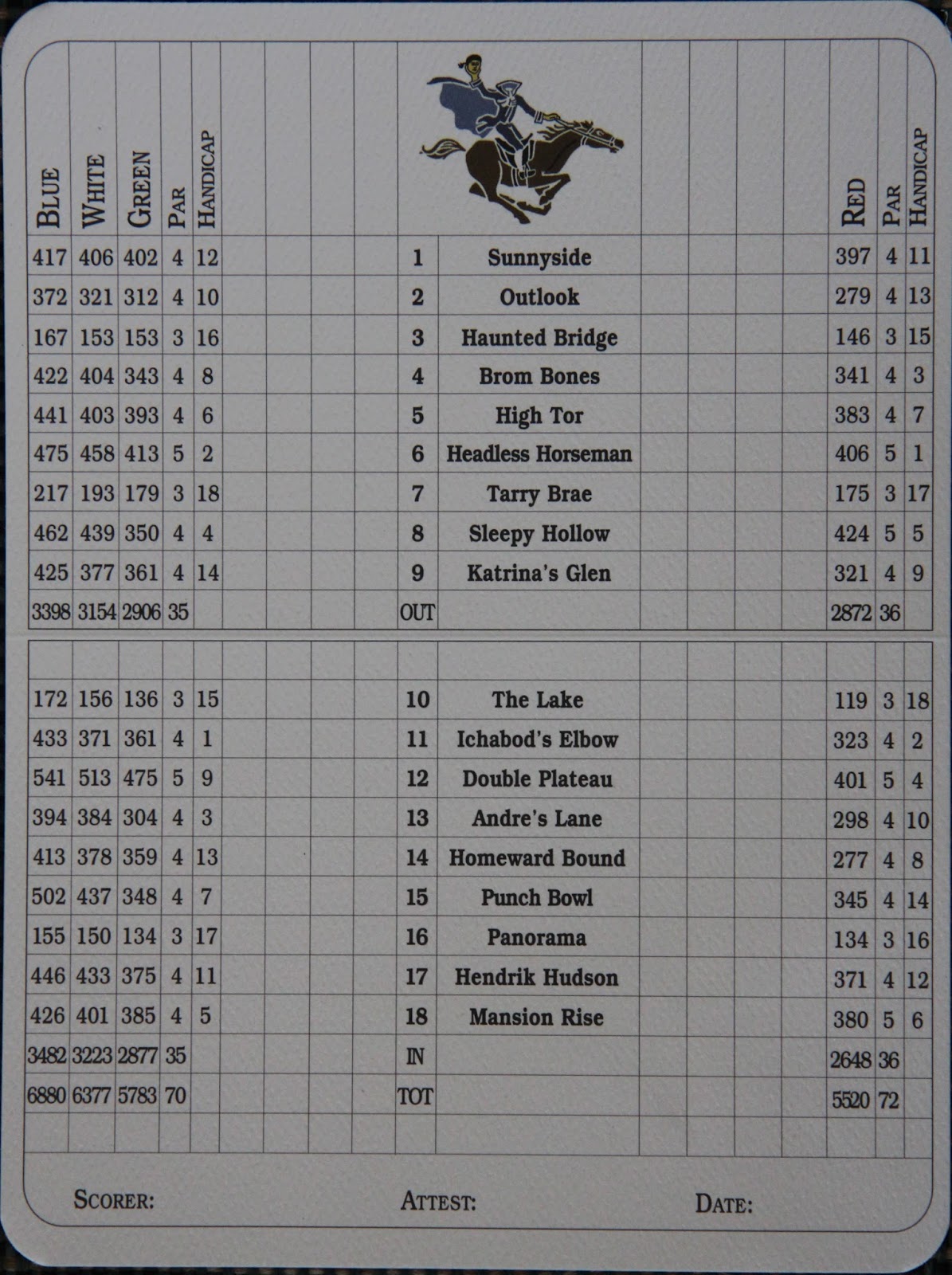
Sleep Hollow Country Club marked the last round of golf during my time in New York City. The summer of northeast golf ended on a great note. Sleepy Hollow is one of the great under recognized courses in the northeast US. In his book, The Confidential Guide to Golf Courses, Tom Doak refers to Sleepy Hollow as, "Westchester's best unknown golf course." This is quite a compliment considering the quality of courses in Westchester County and Doak's notoriously strong opinions. After playing a handful of great golf courses the summer, Sleepy Hollow easily ranks as one of the most enjoyable rounds that I played.
Famous headless horseman club logo
William Rockefeller built the club for a “who’s-who” of New York businessmen. Over after its creation, the members still hold a special place at the club. I had been told by my host member at Winged Foot, “You are going to love Sleepy Hollow. The course is great, but it is the members who make the place so special. They are all really good people.” His advice held true during my visit to Sleepy Hollow.

The first thing to strike golfers arriving on the property at Sleepy Hollow is the mansion clubhouse. The clubhouse is a spectacular old Vanderbilt estate house, known as “Woodlea”. The clubhouse was completed in 1894, and was sold to Sleepy Hollow Country Club in 1920.
The golf course has an interesting history. Charles Blair Macdonald designed and finished the course in 1911, but its history doesn’t stop there. In the late 1920s, A.W. Tillinghast was brought in to add an additional 9 holes to the club. In so doing, Tillinghast created what are now the first, eighth through twelfth, and eighteenth holes, and then knitted them into Macdonald’s course. It created two different flavors coming from two very different designers.

Over the years, various greens committees, with the help of “name” designers, changed the course in attempts to “modernize” it, achieving lukewarm results. In the mid-2000s, Gil Hanse, with the help of Macdonald expert George Bhato, was brought in to restore the course back to its original Macdonald design. The removal of trees, changes in bunkering, and overall layout alterations resulted in what Golf Club Atlas described as, “...a renovation that represents one of the great transformations in the history of golf course architecture. (Sleepy Hollow) went from a lifeless course that had lost its soul, a ‘new old’ course full of character...”

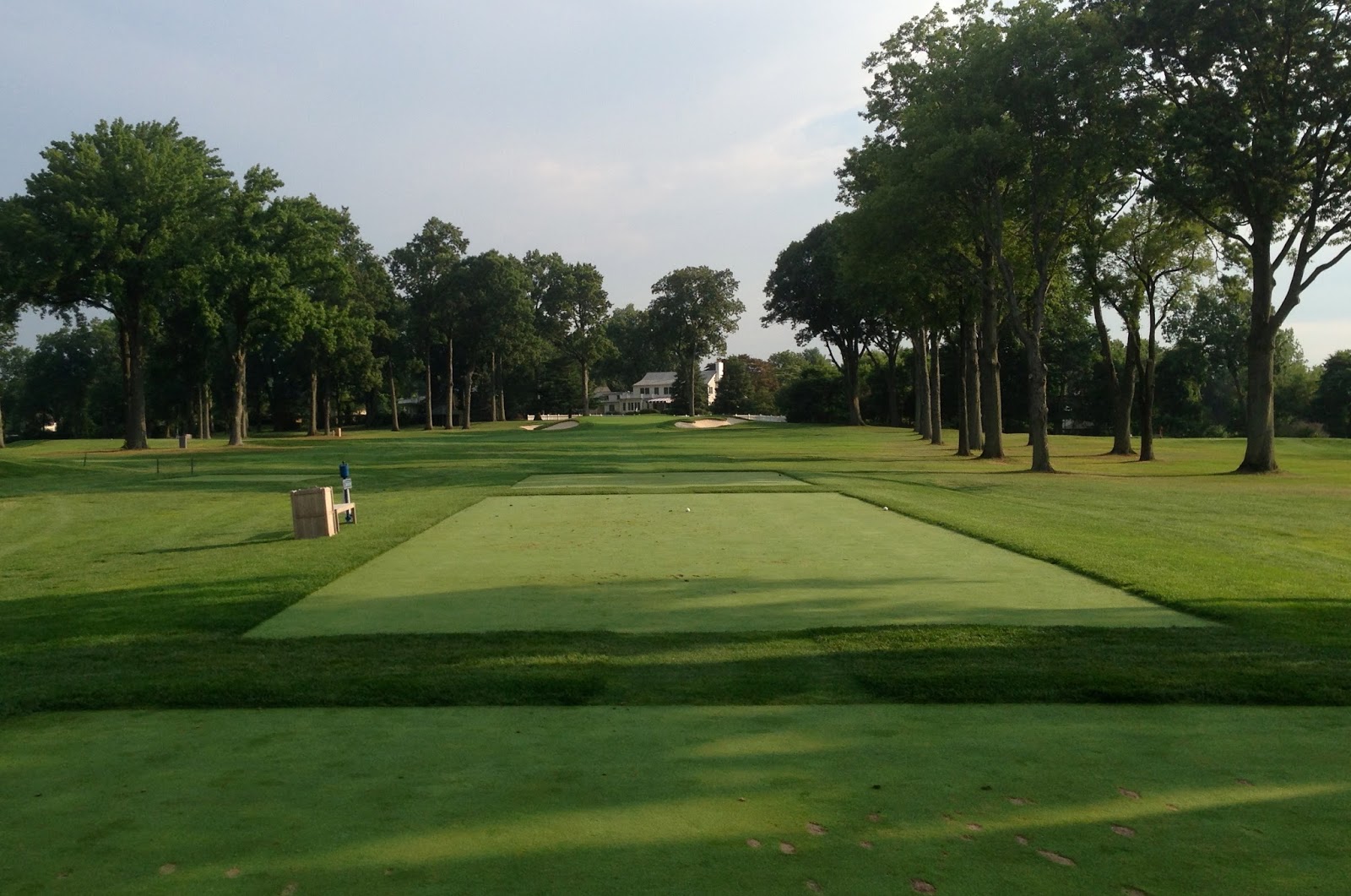
Hole #1 - 406 yards - "Sunnyside"
The round begins with a downhill par 4 moving to the golfer's right. The elevated tee box at the base of the Vanderbilt mansion provides just enough of a view to whet your appetite for the holes to come.

Hole #3 - 153 yards - "Haunted Bridge"
The par 3 3rd requires a shot over a large gorge. This hole is Macdonald's Eden hole at Sleepy Hollow. Bunkers on the left hillside and low right of the green act as tough penalties for any wayward shots. Click on the picture to enlarge and have a closer look at both the green and the unique bridge across the gorge.

Hole #5 - 403 yards - "High Tor"
The tee shot on the fifth is blind cresting a ridge. The photo above is taken from the top of the ridge. As golfers leave the tee box and proceed up the fairway, the view is breathtaking... Some members called this the most improved hole on the course after Hanse did his work. There were once a large number of trees behind this green, completely obstructing the view of the river. Removing the trees opened up the hole and allowed the gorgeous view to come through.

Hole #6 - 458 yards - "Headless Horseman"
This par 5 is an almost 90 degree dogleg right with the bend on the top of the hill seen in the distance. Short hitters play into the valley and then play a second shot up over the hill. Long hitters can cut the corner and play to the top. Part of the brilliance of this hole is that, despite the short length, it is a three shot hole for those unable to carry the ball over 250 yards. The hole is a great use of the terrain.
The picture above shows the approach to the green once on top of the hill.

Hole #7 - 193 yards - "Tarry Brae"
This downhill reverse Redan hole is one of my favorite par 3s which I have recently played. The green slopes right and away from the tee box. A slope short left kicks ball down and onto the green. My photo doesn't show the green particularly well. I could have sat with a bucket of balls on this tee and happily hit all afternoon.

Hole #9 - 439 yards - "Katrina's Glen"
The 9th hole gives golfers a true taste of AW Tillinghast's input at Sleepy Hollow. Holes 8-11 have a noticeably different feel, yet they still flow well with the rest of the golf course. The 9th is a dogleg right par 4. A shot out to the bunkered corner of the dogleg leaves a very interesting 150 yard approach. The green appears to be open for the taking, but bunkers left and right, along with a sloping front present a challenge. 

Hole #10 - 156 yards - "The Lake"
This par 3 is another one of the course's very picturesque holes. It holds a different kind of beauty from the expansive views of the Hudson seen at other points in the round. The hole plays slightly downhill, and a back left slope acts as a backboard for the safe long, left shot.

Hole #12 - 513 yards - "Double Plateau"

The 12th hole saw the largest change during the Hanse and Bhato renovation process. Over two hundred yards were added to the hole, turning it into a par 5. A completely new green complex was created. A long, straight par 4 was turned into an interesting dog leg left par 5, incorporating a creek on the second shot. The name "Double Plateau" comes from the tough, two tier green. Be sure to make note of the pin placement and/or obey your caddy. I did not, and I payed the price with a double bogey. The changes to this hole also drastically improved course routing, which originally required a very long walk from the 12th green to 13th tee.

Hole #13 - 384 yards - "Andre's Lane"
The severity of the slopes in front of this green are not fully realized in this photo. It is a challenging approach shot to the elevated green. The fairway is also filled with strategically placed fairway bunkers. The green also slopes from back to front. That fact combined with fast green speeds dictates extreme caution when putting from above the hole.

Hole #15 - 437 yards - "Punchbowl"
The 15th hole also saw major changes during the restoration. The hole was changed from a par 5 to a long par 4. Average length golfers would have around 100 yards for their third shot into the punchbowl green. This eliminated use of the strategic slope short left of the green. By moving the tee boxes up and creating a long par 4, Hanse fully capitalized on Macdonald's original design. This was one of my favorite par 4s on the course.

Hole #16 - 150 yards - "Panorama"
"Panorama" is a fitting name for this par 3. The bunkering around the green saw a drastic change during the restoration. Small, cluttered bunkers and mounds guarded this green instead of the wrap-around bunker seen today. After looking at a 1920s photo of the hole in the clubhouse after the round, it is obvious that the current design is the original. Greens committees and various designers had changed the bunkering over the decades.

Hole #18 - 406 yards - "Mansion Rise"
The final hole on the course is fairly easy if played correctly. However, enter a fairway bunker or one of the massive bunkers front right of the green and you will pay a huge price. The hole is framed beautifully by the mansion clubhouse directly behind the green. 

I hope to have the chance to play Sleepy Hollow again. The photos barely do the views and beauty of the course justice. The round presented me with the necessary reminder that golf isn’t only about difficult courses capable of hosting major championships. My round at Sleepy Hollow was fun. It required a huge variety of shots, and each hole had unique character. The clubhouse, the overall aura of the place, and my playing partners all combined with the course to make an extremely enjoyable day.

Saturday, August 3, 2013

Winged Foot (East & West)


My invitation to play Winged Foot came unexpectedly. I received an email from a friend at my home club reading simply, “When can you play Winged Foot?” From that point, everything fell into place. A quick phone call lined up a morning to play the very next week. My host member for the day insisted that we play 36 holes, both the East and West courses. After having heard and read so much about the underrated and very good East course, I was in golfing heaven.
As the day of the round(s) approached, the weather forecast looked more and more grim. The morning was supposed to be partly cloudy, breaking into heavy storms around mid-day. Undeterred, I met my host at 6:45 AM in upper Manhattan and we headed north to Winged Foot and a hopeful 7:30 tee off. I specifically avoid the use of the term “tee time” because Winged Foot doesn’t have tee times. You arrive, put your group’s ball in the queue, and wait for your turn to come. We were the first group off. Two golfers with one caddie. It couldn’t have been much better.
Both courses at Winged Foot are strong A.W. Tillinghast designs. I would argue that one course is not necessarily "better" than the other. The West course simply has length and routing that works well for hosting major golf events (5 US Opens thus far among many other USGA tournaments). Comparing the slopes and ratings of the two courses further strengthens my argument. The East course, from 6,792 yards, has a 73.9 rating and a slope of 141. The West course (US Open course), from a comparable yardage of 6,928, has a 73.8 rating and a slope of 137. Going by the numbers, from comparable distances, the East course is harder. That being said, those tees at 6,792 are the longest available on the East.

West Course #1 - 440 yards - "Genesis" (Distances are from Black tees - 6,928 yards total)
What a great name for the first hole... It gives the impression that you are beginning a Biblical journey that will one day be chronicled in something matching the grandeur of Homer's Odyssey. The first hole begins a theme seen all day: fairly normal tee shots and fairways, but brilliant green complexes. Keep an eye out for this theme in the photos. 

West Course #3 - 200 yards -"Pinnacle" 
 The bunkers right and left of this green are very penal. This miss is short, leaving a simple pitch up the center of the green to the flag. It is said that Billy Casper laid up all four rounds on this hole leading to four pars and a victory in the 1959 US Open.

West Course # 6 - 318 yards - "El"
This is a drive-able par 4 for long hitters. Tillinghast's bit of brilliance comes through with the deviously small green and unique "L" shape wrapping around the large right hand bunker. A tall price must be paid if you miss the green in the wrong area. It's a very fun approach and an interesting hole to watch during the US Open.

West Course #7 - 157 yards - "Babe-in-the-Woods" 
As said later in this post, the par 3s on both courses at Winged Foot are incredibly strong. The 7th is yet another example. The elevated green demands accuracy with the approach in addition to a nice, high ball flight to hold the green. Ignore the pin on this hole and aim at the "V" trees behind the green. There is no preferable miss!

West Course #9 - 508 yards - "Meadow"
 The 9th hole plays as a par 5 during general play, but is played as a par 4 during the US Open. The view down the fairway towards the intimidating green complex and grandiose clubhouse sums up Winged Foot very well. You could sit a chair in the middle of this fairway taking in the view... what a place!

West Course #10 - 183 yards - "Pulpit"
 The 10th is the signature hole on Winged Foot's West course. The hole is beautiful and this photo doesn't do it justice. We played the hole into wind and I hit a full 200 yard shot to 15 feet before promptly three-putting for my bogey. It was one of many three putts during the round. The task is not over once you've hit the severely sloping green.

West Course #11 - 391 yards - "Billows" 
The 11th was one of my favorite green complexes and approach shots on the course. A tricky tee shot leaves around 135 yards into a small green. The bunkering frames every hole perfectly.

West Course #18 - 430 yards - "Revelations"
Keeping with the theme, the course begins with "Genesis" and ends with "Revelations." If you have made it this far in the round anything close to level par, you really have done something of Biblical proportions. A huge false front protects this green. You can feel Phil Mickelson's pain walking up this fairway, remembering what happened to him in 2006...

A recent theme of returning courses to original designs has been prevalent in modern re-design projects. Winged Foot has experienced this as well. Aerial photos of the course showed that some of Tillinghast's original greens on the back 9 had become much smaller over the years. Multiple greens coming down the stretch, including the 18th, have been enlarged and returned to original dimensions.

View of the clubhouse from the East Course
After finishing our round on Winged Foot’s legendary West Course, the clouds started to darken and a cool drizzle began. We decided that instead of stopping for a coffee or bite to eat, we would immediately walk to the first of the East course to beat the rain. Without pause, we walked to the East Course and hit away, as if we were simply teeing off on hole 19.

To quote my host member, "Most of the members would rather come out and play the East course..." I would agree with him after playing both courses. The East course has a ton of character and provides a well-rounded test the golf game.

As we teed off on the East course, the rain really began to pick up. This meant that opportunities to pull out the camera were minimal. I didn't take many photos of the course, and in turn, I ended up playing much better than the first 18. Oh well!

East Course #6 - 194 yards - "Trouble"
The par 3s on both courses were incredibly strong. There was great variety in design and length between all eight par 3s on the course. Unfortunately, the rain kept me from getting pictures of the beautiful 3rd hole on the East Course. Number 6, seen above, is an example of the great short holes on this course. 

East Course #15 - 336 yards - "Shrine"
A short club off the tee on this hole keeps golfers safe from the lake in front of the green, and also provides a full shot into this elevated and sloping green. Accuracy is paramount with the approach shot. My member and caddy pointed out very subtle ridges running along this green that could provide for extremely difficult pin placements. 

East Course #17 - 227 yards - "Lightnin'"
 The 17th hole on the East course serves to remind players that it is just as challenging and well designed a course as its brother, the West course. The tough downhill par 3 is long and has a tricky green. The pin was tucked deviously behind a tough little ridge. The miss on this hole is short. Long, left, or right are very tough up-and-downs.

I couldn’t have been in a better place walking off the 18th of the East course. I was dripping wet, but bone dry under my Galvin Green rain suit. We walked into the beautiful clubhouse and proceeded to the upper floor of the Winged Foot locker room. The locker room is two stories. There is a member-member golf tournament every year where to two floors play against each other. After a hot, relaxing shower (7.0 on the PowerShower scale), we headed downstairs into the men’s grillroom for a nice lunch.

Something that strikes you while experiencing Winged Foot is the club staff. Every staff member seemed to have been at the club as long or longer than my member (20 years). My excellent caddie, Jim, had been at the club since 1977, and seemed to know every intricacy of the courses, along with the membership. To quote from my friend the “Top 100 Golfer,” “You are served by employees that have perfected the art of service and making you feel at home... When Henry Longhurst wrote "one of the great unpurchasable assets in any golf club is the continuity of staff", he must have been thinking of Winged Foot.” 
West Course

     
East Course