Showing posts with label Open Championship. Show all posts

Wednesday, March 5, 2014

Carnoustie Golf Links

Carnoustie Golf Links is one of the strongest links course designs in Scotland. A round at Carnoustie tests every aspect of a golfer's game, and any lapse in concentration destroys the scorecard. The course is most commonly known for Jean van de Velde's self destruction during the 1999 Open Championship and the extremely difficult course setup that same year, which led to a +6 winning score. As time passes and Carnoustie becomes distanced from those events, hopefully the course will become less known for its penal past, and better known for its great design. 
The recognizable Carnoustie hotel with a uniquely modern new welcome center seen on the right.
As you will see in the photos below, Carnoustie is not visually stunning, especially on a grey March day. The course has little "wow" factor, but is absolutely deserving of its ranking at #23 in the world. Golfers know that they have played something special after walking off the 18th green. To quote a friend of mine who has played the world's best golf courses, "If every golf course has a personality, Carnoustie is that of a working man. Looking over Carnoustie from the first tee and you are bound to be disappointed. Be patient, however, and you will be rewarded."

The course was originally laid out as a 10-hole track by the St Andrean Allan Robertson in 1840. Robertson was Old Tom Morris's employer and mentor, and it was Old Tom who extended the course to 18 holes in 1867. In 1926, Braid added final routing touches that have lasted through to the current design. When looking at the photos in this post, it is worth keeping in mind that the rough has been cut down for the winter. Very high rough borders the fairways and greens during the summer months.

Hole #1 - 389 yards - "Cup"
The course opens with a straight par 4. A sunken green creates a blind approach that is guided by a large white target pole. Bunkers down the right side of the fairway are a gentle introduction to the penal bunkering found later in the round.

Hole #2 - 407 yards - "Gulley"
The view from the 2nd tee, as seen above, is intimidating with a seemingly bunker filled fairway ahead. The hole has a total of ten bunkers, and staying out the them is paramount to a good score.
The green, pictured above, is over fifty yards in length. Two bunkers guard the front left and right positions, while a single bunker on the left sits midway up the length of the green. Elongated greens with bunkers placed mid-putting surface are seen again later in the round.

Hole #3 - 331 yards - "Jockie's Burn"
Heavy rains and cold temperatures this winter caused a winter green to be in play on the 3rd hole during my round; therefore, ignore the white pin seen to the left of the green. The 3rd is a short hole that requires creativity and thought in order to be successful. Golfers must carefully choose a landing area, factoring in three deep bunkers and a meandering burn in front of the green.

Jockie's Burn is just short the 3rd green and is one of many to be seen later in the round. When the greens are fast and the turf is firm, this meandering stream is particularly dangerous.

Hole #6 - 500 yards - "Hogan's Alley"
The 6th hole is one of only two par 5s at Carnoustie. A well placed drive is crucial on this hole in order to place a second shot close to the green. Out-of-bounds is much closer on the left side of the hole than it appears in this photo. The four bunkers on the right are particularly deep.


Ben Hogan only played one Open Championship during his long golf career, and it occurred at Carnoustie. He spent a number of weeks before the event practicing at Panmure, getting accustomed to the links turf. This hole is named after Hogan, who famously hit his four drives through the narrow "alley" between the bunkers and out-of-bounds fence. He won his only Open Championship with the ever descending scores of 73-71-70-68.

Hole #8 - 157 yards - "Short"
The first par 3 of the course comes late on the front nine. The short 8th initially seems simple, but the long green is full of subtle variations. When the course is playing firm and fast, it is difficult to hold this green, especially downwind.
The bunkering to the right of the green is not particularly deep, but the unique shape leads to interesting stances near the bunker wall.

Hole #10 - 417 yards - "South America"
The Barry Burn makes its first major intrusion of the round on the 10th hole. The famous burn guards an area fifty yards short of the green, and, depending on the wind, it can really come into play. The area to the right of the 10th green is also one of the rare examples of greens affecting play on a Scottish links course.

Hole #12 - 407 yards - "Southward Ho"
The 12th hole is not the most interesting on the course, but it is an excellent example of the bunkering found at Carnoustie. The photo above shows the view from the tee box, where it is easy to be "psyched out" by the massive traps guarding the hole. The green is larger than it appears from the fairway, and a back left pin puts a premium on positioning in the fairway. The 12th only gets more difficult when imagining thick summer rough on the left side of the hole.

Hole #13 - 141 yards - "Whins"
The second par 3 in the round comes at the 13th, and the green complex is very interesting. The green is guarded on three sides by deep bunkers, and the green slopes from right to left. The pin in the photo above is in the back left location, which brings the left hand bunker into play. The 13th is a great test of a golfer's short irons. 

Hole #14 - 459 yards - "Spectacles"
Bunkers abound in this intimidating tee shot on the famous 14th hole at Carnoustie. The left three bunkers challenge the tee shot, while the two spectacle bunkers in the distance (and pictured below) come into play during the approach. After avoiding bunkers off the tee, golfers must choose whether to challenge the massive spectacles on their second strikes.
The famous spectacle bunkers guarding the approach on the 14th can be seen above. They are truly massive.

Hole # 16 - 235 yards - "Barry Burn"
At this point in the round, the group in front of me walked in because of heavy winds, and I joined a remaining brave local who was willing to stick out the gales. In the process, I missed my chance to take a photo. The 16th is a very long par 3 with a large raised green that slopes off on all sides. This is another hole at Carnoustie that is not flashy in any way, but it requires an excellent tee ball to hit the green in regulation.

Hole #17 - 421 yards - "Island"
After playing Carnoustie twice, I am still none the wiser about how to tackle the 17th hole. The photo above shows the snaking Barry Burn meandering through the hole. The landing area is between 150 and 240 yards, unless golfers want to take on the 260+ carry over the burn. Golfers standing on the tee who have never seen the hole before would have no idea where to hit the ball. I have added an aerial diagram below in an attempt to do the oddness of the 17th justice. Once the burn is avoided off the tee, a long approach over green side bunkers is still required.
Aerial view of the complicated and difficult 17th hole.
Hole #18 - 421 yards - "Home"
The final hole at Carnoustie is the famous site of Van de Velde's meltdown in the Open Championship. If the hole is playing downwind, a long iron or fairway wood will leave golfers short of the Barry Burn, which once again meanders dangerously through the hole. 

The long green is guarded by bunkers on both sides, and the approach shot can be very long depending on wind direction. It is a fitting end to a very challenging round of golf. Leaving the course having shot a respectable score is a real achievement at Carnoustie. There are very few "easy" shots on the course and any lapse in concentration can result in a meltdown (see Van de Velde in 1999 and Harrington's final double bogey in 2007).

The enjoyment of playing Carnoustie does not lie in breathtaking views, awesome facilities, or the flashiest design. The great experience comes from playing a very strong course design, having every facet of your game tested at the highest level, and playing on a stage that has hosted some of golf’s most memorable championship moments.

Thursday, December 6, 2012

St Andrews Old Course Renovation Photos

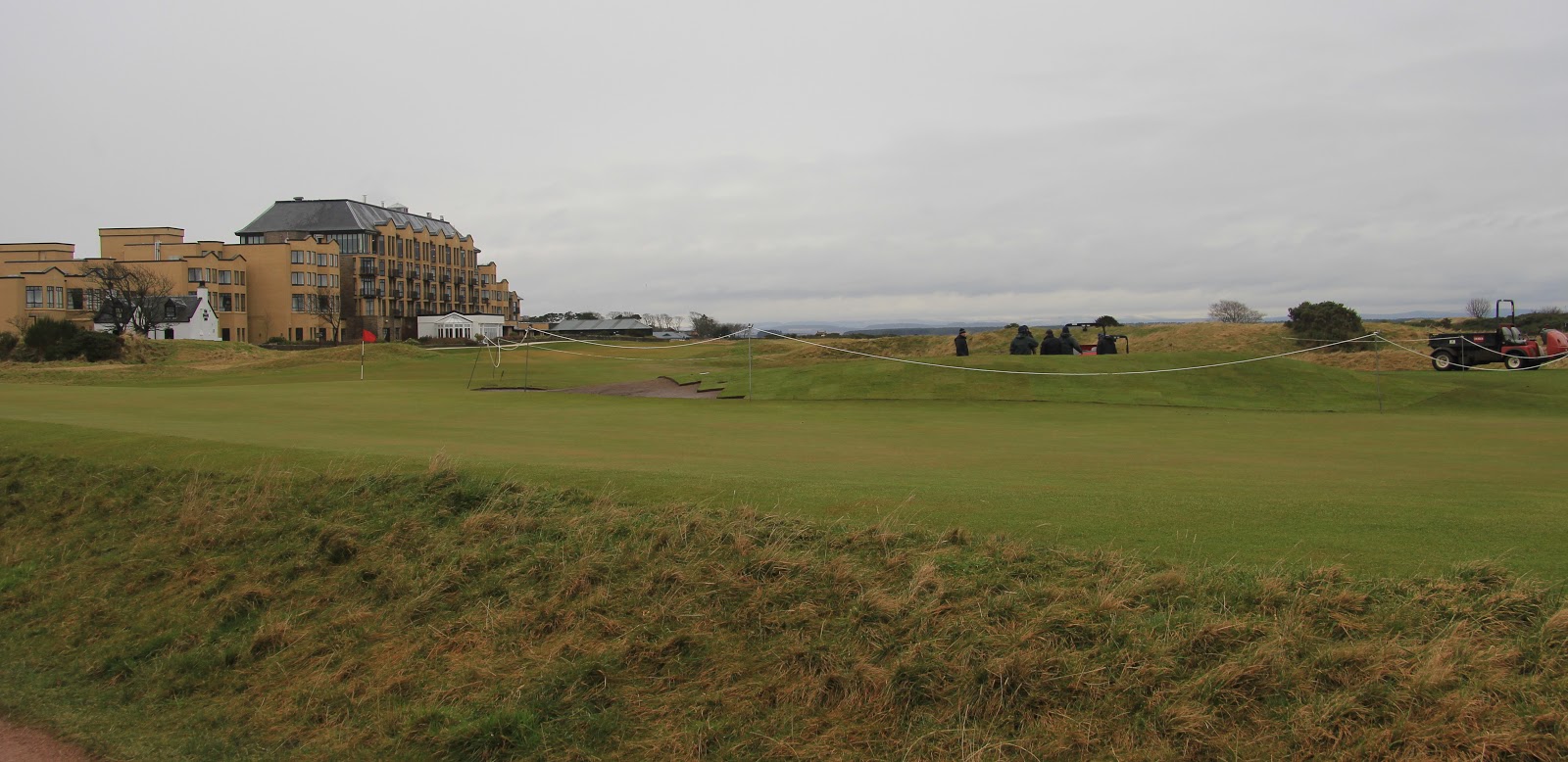
I took a cold and rainy walk down on the Old Course this morning in order to take photos of the renovations that are currently taking place. To read my post outlining the changes, read here. I have posted the photos in order of convenience to walk, not in order by hole. Click on the photos to enlarge.

17th Hole
2nd Hole
A good view of the old bunkers (being filled in) with their new larger, shifted versions in the background
7th Hole


Large span of gorse removed in front of tee
11th Hole

Monday, March 19, 2012

Muirfield

This latest round at Muirfield, or the Honourable Company of Edinburgh Golfers (HCEG), marks the second time that I have played the course. The first time we played the exclusive track, the wind was blowing 40 mph+, which made for a frankly unenjoyable round. With this second visit, we were able to fully experience Muirfield for everything that it offers, from a challenging golf course to an incredible lunch. The overall experience at Muirfield is hard to beat. It is different from nearly every other club and it oozes tradition.
View up the 18th with the historic clubhouse in the background
            Upon arriving at Muirfield, we dropped our bags in the beautiful locker room before making our way to the very friendly bookings secretary with whom I had been dealing when arranging our tee time. Lucky for me, my home club (BFCC) has a unique connection to Muirfield.  I learned that the booking secretary had even been over to North Carolina to play my home track! After checking in, we had a nice coffee in the smoking room before changing out of coat and tie and proceeding down to the range to loosen up after the long drive from St Andrews.
Deep, small bunker on the par 3 13th
            Two things are vital in order to shoot a low round at Muirfield: don’t miss fairways and avoid bunkers. Very thick and high rough borders every single fairway. The rough was extremely tough. Keep in mind that we played the course in March, when the rough is lower than the summer. Combine this penal rough with bunkers seemingly everywhere and you have a good idea of the course. The bunkers are extremely well placed. Any errant tee shot or approach shot risks falling into one of these scoring death traps. A birdie on the final hole sealed my score of 77, but what was I most proud of? I only went in one bunker!
Driving off the 7th tee
            Post-round, we took a long shower in the locker room, changed back into our coat and tie, and proceeded into the large dining room to join some members for the feast of a lunch. We began the feast with cold cuts of meat, fish, salad, soup, and the like, piling our plates high enough to draw a “Have you been dieting?” from the member sitting next to us. A delicious cut of roast beef served as a main course followed by a massive choice of puddings and/or cheese, which capped off the mouthwatering meal nicely.
            As mentioned in my first Muirfield post, the dining room is steeped with history. Anniversary silver plates from clubs such as the R&A, Pine Valley, and Augusta National adorn viewing cases surrounding the banquet style tables. Ancient clubs, balls, and trophies hang on the walls. The surroundings and ambience add greatly to the “full Muirfield experience” of which you hear nearly everyone who has played the course speak.
View of the 12th green with bunkering on the right, and unseen bunkers hidden on the left
            What happened after our meal is where our day at the HCEG differed from that of the normal visiting golfer. We retired to the smoking room for a glass of kummel to soak up the last drops of the club before heading home. We were peering into the dining room trophy case when the clubhouse director of staff came by and asked if we would like to see “the real stuff.” He took us past the dining room into the Muirfield Room, where members can relax, watch TV, or eat breakfast when staying in one of the overnight rooms located upstairs in the clubhouse. We were then taken into a back hallway which contained original framed scorecards from historic rounds at Muirfield. Among these cards were Walter Hagen’s original 1912 course record scorecard and Nick Faldo’s final round scorecard of 18 pars to win the 1987 Open Championship. This corridor led to the Captain’s Room which consisted of paintings and a boardroom style table. I can only imagine the conversations that have taken place in that room...
The approach to the 9th green with difficult bunkers spotted up the fairway
            This exclusive peek into the members’ areas of the Honourable Company of Edinburgh Golfer’s clubhouse marked the end of our day. As we passed back through the iron gates towards the car park, we all shook our heads knowing we had just seen what every golfer dreams of seeing, knowing few ever will.
            I have heard and read reviews of Muirfield claiming that the golf course is overrated. I disagree... The golf course isn’t very picturesque, but it is a very difficult and well-designed test of golf. If any aspect of a golfer’s game falters, the course will tear it apart. The design tests nearly everything in the game. I am looking forward to watching the 2013 Open Championship after having experienced Muirfield in both its docile conditions and its most brutal.            

Wednesday, August 10, 2011

Turnberry

My round at Turnberry was early during my time in Scotland and this review needs more detail and photos. I will hopefully visit Turnberry again soon for another round.

My good golfing buddy Matt and I travelled down to the west coast of Scotland by train the night before our round at Turnberry. Due to ignorance and a strong will, we had decided to avoid taxis and walked four miles the previous night from the train station to our accommodation at the Ayr Travelodge. We ended up entering the Travelodge about midnight very tired and ready for a good night’s sleep. We were eager to get down to Turnberry to play the first of what would be a number of good rounds on the west coast.
Upon arriving at Turnberry, a visitor’s eyes are drawn to the impressive hotel on the hill overlooking the course and ocean. The locker room is massive and can accommodate the large number of visitors and members alike that play the course. The place exudes a resort feeling, which, while nice, stands in contrast to the small Scottish clubs in the area. Despite the well-equipped locker room, the PowerShower rating is a disappointing 3. We had a few very good bacon rolls overlooking the golf courses at Turnberry and settled into our great day.
The golf course begins with a fairly straightforward par four, easing the golfer into the impressive and difficult golf course. The second is another well-bunkered fairway that moves to the player’s left with views of the famous Ailsa Craig and the ocean to framing the hole. Good drives are required throughout the front nine in order to set up angles into the greens. It was difficult to score well at Turnberry having never seen the course. We were constantly referring to our Strokesaver, and I would recommend hiring a caddie. The famous 9th hole lived up to its legendary beauty with the recognizable lighthouse to the player’s left off the tee.
The 10th was one of my favorite holes. A downhill tee shot provides a great view down the dogleg left hole. The view looking back from the green is one of the best on the course.

The final stretch of holes is very enjoyable and the par 5 17th allows for a birdie chance before the round comes to a close. The 18th hole is named “Duel in the Sun” referring to the famous finish during 1977 Open Championship between Tom Watson and Jack Nicklaus. I channeled my inner Tom Watson and hit a pitching wedge tight for a final birdie on the 18th hole. sealed victory for myself and left a good taste in my mouth for the entire Turnberry experience.  

Tuesday, August 9, 2011

Prestwick Golf Club

My rounds at Prestwick were early during my time in Scotland, and I hope to make it back to the course soon to write a more extensive hole-by-hole review.

Prestwick Golf Club is one of my favorite courses in Scotland. The club exudes golfing history and the course embodies the meaning of quirky Scottish links. The course was bred in its infancy by one of my heroes, Old Tom Morris. Prestwick hosted the first eleven Open Championships and its members were responsible for creation of the championship belt and claret jug. There are few courses with more early golfing history. Prestwick hosted its last Open in 1914.

I have been to Prestwick twice for a total of three rounds. My first visit was during a University of St Andrews Men’s Golf Club match against Prestwick Golf Club. The traditional match began with tea and coffee before a morning foursomes round. After the morning round, players put their coat and tie on for a large traditional lunch followed by kummel. After lunch it is back to the course for a second afternoon foursomes round. The traditional Scottish golf club match is a great full day experience. After many drinks, two rounds, and a great lunch, you have made friends at another club that can last a lifetime.
My second visit to Prestwick was three weeks later and I expected to be treated as an average anonymous visitor. Instead, upon arriving at the course, the club secretary immediately came out to personally greet Matt and myself. Recognizing my name from the starter sheet he said, “You just had to come back for more!?” We were served coffee in the members’ smoking room and then allowed to use the members’ locker room during our stay. It is this personal touch, matched with great golf, which makes Prestwick one of my favorite courses in Scotland.
I did not manage to take many photos during any of my rounds at Prestwick. The course gets mixed reviews from guests who come expecting great views and a modern championship track. This is the wrong attitude to adopt when playing Prestwick. Instead, embrace the history and quirkiness of the great place, and prepare yourself for plenty of blind shots.
I remember nearly every hole at Prestwick very well, but certain holes stand out in my memory. A stonewall runs down the entire right side of the first hole, making for a challenging opening tee shot. The 5th hole is a truly blind par 3 with a large hill standing between tee and green. Golfers know which section of hill to hit over using stone markers on the horizon line and a box on the tee marking pin positions. The 17th hole is another blind approach to a well bunkered and sloping green. These quirky holes add to the experience and the whole club has an ambience harkening back to the days of Old Tom Morris. The 18th hole is short and can be driven depending on the wind. It’s not the most challenging finish, but it leaves a great taste in your mouth to finish with a birdie! 

Dundonald is a  Kyle Phillips design on the Ayrshire coast. The course has a distinctly American feel, while also featuring the burns, dunes, and firm turf of a links course. It stands in stark contrast to Prestwick both in design and history, having only been built in 2003. It is owned by, and is a designated sister course of, Loch Lomond Golf Club. If in the Ayrshire area and looking for a very challenging and long course, check out Dundonald. We played the course on a very windy day, and we were beaten into submission on the back nine.


The picture posted below is a bunker behind a par 3 green on Dundonald. It was one of the deepest and smallest bunkers I have ever seen.